Saturday, March 5, 2022

Reading Banned Books

In the midst of the horror of Putin’s attack on and invasion of Ukraine, it seems petty to write about anything else. Another part of me says those of us who are able also need to keep living and functioning while we still can. The outpouring of aid in the way of helpers, goods, and money going to those having to flee their homes because of that man’s madness is at least something to give us hope. Reading and writing is a way for me to keep a grip on what still works in this world.

Before Putin’s war started I was planning my reading strategy for the next few months: focusing on books banned at some time and place in the US during the last several decades. That began after I found out that Art Spiegelman's Maus had been removed from the 8th grade curriculum in a Tennessee district due to nudity (it’s a graphic novel about the Holocaust featuring mice as the main characters) and a few “naughty words.”
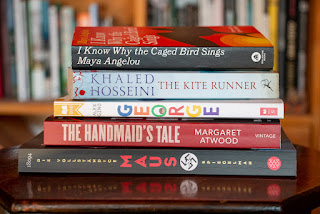
Not pictured: Looking for Alaska
I gave it to a friend to read.

Notice: This post contains no spoilers. 

I ordered the book again (having left my first copy in my German classroom when I left the US), though I accidentally ordered the German version. Therefore I can’t speak to the “naughty words” other than assuming “verdammt” (damn) was a problem. And indeed, there is a drawing of a human in a bathtub – the author’s mother in a flashback scene – and two curved lines and dots amount to human breasts. In a drawing. These book-banners are unbelievable. Spiegelman’s graphic novel is a brilliant way to introduce young readers to the horror of the Holocaust. The fact that the Jews are mice and the Nazis cats softens the shock a bit for younger readers. But because of two breasts and a few swear words, this group of parents and/or school board members thinks the book should be removed.

From there I moved to the Handmaid’s Tale, which I found less shocking than I expected to. That one has been banned/challenged for profanity and “sexual overtones.” Those who aim to ban books haven’t been listening to their children or their children’s friends, have they? It's more than a little ironic that the book-banners don't object to the fact that an entire class of women are nothing more than breeding machines with no rights, but a few swear words put them on alert.

Looking for Alaska was the next one, having earned a spot on the Office of Intellectual Freedom's Top Ten Most Challenged Books list several years running. Challenged because of a sexually explicit scene that could lead readers to experiment and for profanity. I’m sorry to say I don’t even remember the sexually explicit scene. Very briefly put, it tells the story of several teenagers at a boarding school and the struggles of growing up. 

George, by Alex Gino, was my next banned book, having appeared as #1 on the above Top Ten list for the last 3 years in a row. This is a YA (young adult) novel about a child in grade school who was born a boy but is sure she is really a girl. It’s a story told from the point-of-view of a trans girl, and that apparently scares book-banners. One of the stated reasons for the challenge is that the book contains a transgender character. I think they fear that reading such a book might make a reader say, “Yes, that is the life I want for myself.” I'm no expert, but I'm pretty sure that’s not the way it works.

My most recent book was The Kite Runner. I’d heard of it before but didn’t know anything about it. This multigenerational novel tells the story of two boys from Afghanistan: Amir and his family’s servant’s son Hassan. I got choked up on the last page, and that does not happen to me often. The objections to the book that I find most ridiculous are that it could promote Islam (several of the characters pray, some regularly) and that it contains homosexuality. It does NOT contain homosexuality, for heaven’s sake. There is a rape scene and both perpetrator and victim are boys. But that is not homosexuality. Do we describe a rape scene where the perpetrator and victim are different genders as “heterosexuality”? Honestly…

I’m now reading I Know Why the Caged Bird Sings, by Maya Angelou, and feeling somewhat scornful of myself for not having read this earlier in my life.

The other books I have read so far this year, with the exception of Getting Along with the Germans, would very likely also be banned or challenged somewhere in the US because of “profanity.” It seems that the appearance of even one “goddamn,” “fucking,” or “holy shit” can get a book challenged by people who clearly don’t spend much time around the young readers they are pretending to protect from the realities of the world. 

I watched the part of a school board meeting in McKinney County, Texas in which students, parents, and teachers were invited to speak about a list of 282 books a set of parents wanted removed from the library shelves, and my jaw dropped several times. Already during the second speaker a man had to be thrown out for trying to shout her down for opposing the ban. Happily there were others who also spoke against the challenge. Here is an open letter from the author of one of those books, which I have on order. The letter fell on deaf ears because it was published before that school board meeting. What else would you expect?

One parent said he objects to his tax money paying for books he finds offensive to be on the shelves. I could almost understand that, until he said parents who don't object to those books should just go out and buy them. Some children can only read what the library provides because their parents cannot afford to order from Ama*on every time their child wants to read a book. How much of that first dad's tax contribution goes toward a $14 book? Or even 282 $14 books? He needs to sit down.


As one person on Twitter wrote, “Parents, your kids have access to the entire internet on their phones almost all day long. Books are not the problem.”

"STOP BANNING BOOKS!!!"


On the other hand, the best way to get kids to be interested in something is to tell them they shouldn’t be. The best way to get kids to read a book is to tell them it’s off limits.

But seriously. Stop banning books. Go to your child's library, give the librarian a list of the books your sheltered child is not permitted to read, and leave the rest of the world alone. Better yet, when your child wants to read a book, you read it also and talk about it together. Oh damn. I forgot. One of the challenges to the book George (see above) was that "schools and libraries should not 'put books in a child's hand that require discussion'." Good grief.

By the way, book banning is not a thing in Germany nowadays. It was once, but they've wisened up since then. 


Tuesday, February 15, 2022

Kestrel Rescue

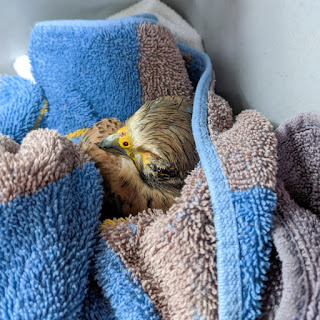
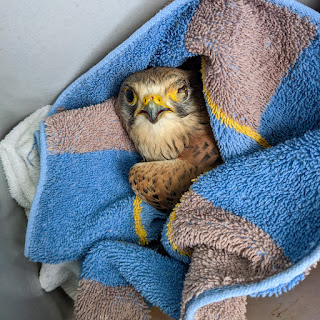
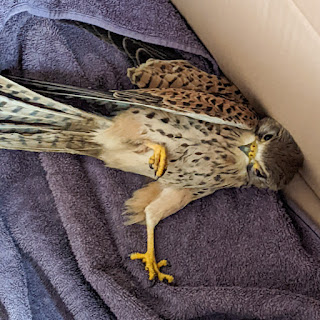
I might have saved a wee Turmfalke (Kestrel, a small falcon) today, at least from death under the wheels of some vehicle or being finished off by crows. For a falconer this is nothing remotely new, but this was my first time, so it has been quite an experience for me.


I was actually on my way to Hekate’s Voliere, because her falconer is in France on business and asked me to look after her. At one point I saw a small bird or owl right on the side of the road as I drove past. I have too often seen buzzards (hawks) too close to the road and feared for their safety if they should take off across the road in front of a car. This little one was way too close, so I screeched to a halt, parked off the road, grabbed my falconer’s glove and went over to shoo it away from the road. I crossed to the other side so I would approach it in a way that, if it could fly away, it would do so toward the field rather than the road. Then I saw a bus coming! I gestured to it to slow down and cringed, hoping he wouldn’t drive any closer to the right! The resulting wind knocked the bird over, but it was still alive. I crossed over to her (by now I could see it was a Turmfalke and was pretty sure it was a female) and saw right away that one eye was badly injured. She also couldn’t fly away, so she tried her best to scare me off.

I talked soothingly to her while she tried to fight me, gently grabbed her so her wings were against her body and her little talons were somewhat secured, and brought her back to my car.

poor little dear


For crow hawking I always have hand towels and a rectangular bucket in the car, so I swaddled her in the towel while she tried to bite and claw me, laid her in the bucket, covered her with another towel and wondered what the hell to do now. What a time for my mentor to be out of the country!

I sent her and M a message asking for ideas but drove to Hekate's Voliere, since I knew there was a vet's number there who deals with raptors. Hekate was clearly happy to see me, confident I'd be bringing her lunch. My mentor sent me the phone number of a falconer she knows who might be able to help, so I called him. He picked up on my second try, rather confused (and at work). Once he understood the situation, though, he told me where he was - basically back very close to where we live! I apologized to Hekate, jumped back into the car, and drove to where the falconer (Ron) was, checking every 5 minutes or so that the falcon was still alive. Ron had a look at her, determined the eye injury might not be so bad but her left wing was also broken, so there might not be much hope. There was still plenty of life in her as she tried to claw and bite Ron, who at one point asked me to pry one of her talons out of his hand.

We went to Ron’s van where he had a cardboard box, and as he opened the back he said, “I have a bird in here.” Sure enough, one of his falcons was sitting on her cadge on the floor of the van. The life of a falconer…

Ron put Kessie* in the box with the towel, and she just lay there, poor thing. He said he'd call a vet he knows who specializes in raptors, and he'd keep me posted. He warned me that a broken wing on a Turmfalke is usually too hard to repair because they are so small. And perhaps she would die quietly in the box - but at least it wouldn't be on the side of the road. I said I couldn't just leave her there, and he said he would have done what I did.

*I definitely did not name her Kessie, because you shouldn't
name wild animals that might not make it.

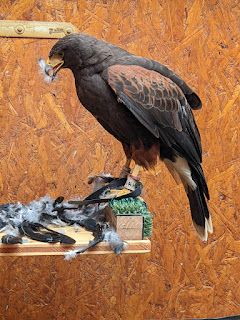
I drove back home to eat something and then returned to a confused but hopeful Hekate. She knows me well by now, but this was the first time I was with her alone. She came right to my glove, sat patiently while I fumbled to secure the jesses, stepped onto the scale like a good girl, and then when I released her back into her Voliere, she went right to the feeding perch and banged on the door to make it clear to me that I was to feed her. NOW. I really am like the staff. I serve her her meal (a yummy crow wing I’d kept in a plastic container in our fridge since Sunday), wait while she eats, and then I get to clean up the mess she made. Feathers everywhere. I should have taken a picture of that. The photo below is just what was on her food perch. The entire ground was full.

Dude, you've got feathers stuck to your beak.

Staring intently at the Futterklappe (food hatch)
hoping for more

A few hours later I got a call from Ron, who said the vet was not put off hearing about the Turmfalke’s broken wing, and so there’s still some hope. I hope Kessie makes it! I will post an update when I know more.

Finally fed and content again


Update: The Turmfalke / kestrel was humanely euthanized by the veterinarian after it was determined that nothing could be done for her.


Friday, January 21, 2022

Shooting in English

Vor Kurzem hat jemand in einer Facebook-Gruppe für Falkner eine Frage gepostet:

„Gäbe es zufällig Falkner aus Bayern, deren Tiere man für ein Shooting buchen könnte?“

Ich bin Amerikanerin und meine Muttersprache ist Englisch. „Shooting“ ist ein englisches Wort und bedeutet „Schießerei“. Also, nein, ich bin mir sicher, dass keine Falkner – egal wo – würden zulassen, dass ihre Greifvögel und Eulen für eine Schießerei gebucht werden.

Wenn ich meinen Eltern eine E-Mail mit dem Betreff „Shooting at a falconry center“ schreiben würde, würden sie schockiert weiterlesen, um zu schauen wie viele Menschen und Tiere erschossen wurden. Es passiert immer wieder in den USA. Ok, eher in Schulen und Gebetshäusern als in Falknereien, aber du verstehst, was ich meine.

Das könnte ein Fotoshooting sein.


Ich weiß, viele Deutsche denken, "Shooting" ist eine Kurzform von "Fotoshooting". So steht es sogar auf dict.cc. Aber das ist leider nicht so. Und weil Amis (besonders wir aus dem Mittelwesten) so ungeheuer höflich und nett sind, werden wir euch niemals korrigieren. Wir werden kurz mit großen Augen schauen, versuchen das Kopfkino schnell umzustellen, oder, wie immer wenn wir etwas nicht verstehen - lächeln und nicken.

Wir hören "Shooting" und unser Kopfkino fängt hier an.

Aber jetzt sage ich es, meine liebe deutsche LeserInnen…bitte hör auf, „Shooting“ zu sagen und zu schreiben. Es ist „photo shooting“ oder „Fotoshooting“. Ganz ehrlich.

Stell dir vor, wir Amerikaner fangen an, das deutsche Wort „Schießerei“ zu benutzen, weil Fremdwörter cool sind:

  • „Are there any dog owners out there who book their pets for a Schießerei? I need some practice!”
  • “There was a Schießerei before my friend’s wedding last weekend. It was so nice!”
  • „When we arrived at Ludwigsburg Castle for our tour, there was Schießerei going on!”
  • “I’m available for Schießereien! Click here for my prices.”


Das könnte ein Fotoshooting sein,
aber kein Shooting!


Ich gebe zu, wir verwenden verschiedene Versionen von "to shoot" auch im Bereich Fotografie und Filme:
  • "How many pictures did you shoot today?"  (Fotos machen)
  • "Oh, that's a good shot!"*
  • "I got a lucky shot of a falcon the other day."   (Foto)
  • "How long did the shoot take yesterday?"    (Foto- oder Filmentermin)
*Das kann beides bedeuten: Du hast ein tolles Foto gemacht, oder du hast [mit einem Gewehr] gut geschossen. Aber für die zweite Bedeutung (gut geschossen), würden wir das eher im Präteritum ausdrücken: "That was a good shot."

Aber schau mal. Diese zwei Sätze bedeuten überhaupt nicht das Gleiche!

  • “No one was injured during the shooting yesterday.”   (Amoklauf/Schießerei)
  • "No one was injured during the shoot yesterday.”  (Film/Fotographie)

"Shooting" bedeutet für einen Amerikaner nur eines: eine Schießerei oder ein Amoklauf.

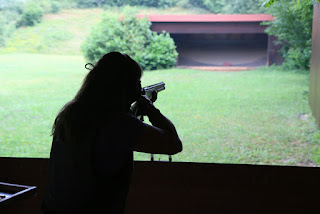
Oder als Verb: In this photo I am shooting at a target.


Es gibt weitere englische Wörter, die Amerikaner anders verstehen, als die Deutschen sie verwenden. 
Beispiele (und zum Schluss ein deutsches Wort, das die Amerikaner falsch verwenden):

  • Handy (für Amis ist das ein adjektiv und bedeutet "griffbereit")
  • Public Viewing (vor einer Beerdigung, wenn der Sarg offen liegt, damit man dem Verstorbenen seine letzte Ehre erweisen kann)
  • Backside (Po;  für "Rückseite" braucht man ein Leerzeichen - "back side")
  • Body bag  (Leichensack)
  • Football  (amerikanischer Fußball, NFL)
  • Foosball, "Fußball"  (Tischkicker)


P.S. Ich begrüße Korrekturen, wenn ich etwas falsch formuliere. Schick mir eine E-Mail (link oben)!


Monday, January 10, 2022

The One I Didn't See

Yesterday I had a Harris hawk on my glove who was very disappointed in me. How do I know this? Because of the circumstance and the look on her face as she stared pointedly into my eyes. Am I projecting? Sure. But I’ve been a teacher long enough, and I know that look.

We had spotted a crow strutting around on a sloped field close enough for Hekate to have a good chance, and we had to turn around to get back there. Hekate was on my glove and her falconer was driving. She and I were focused on where we were turning, when suddenly Hekate launched herself to my right. She is not tied to my glove, but I hold her jesses (Geschühriemen) tightly enough between two often frozen fingers that she can’t get loose just by deciding it’s time. As I said to her, “Not yet, there’s nothing th…” I looked to my right and saw a magpie (Elster) standing at a perfect distance, frozen in place. Arg!! It was too late by then because the magpie figured out he’d better bugger off, so Hekate settled herself back on my glove. And then she looked at me.

I don't have a photo of "the look."
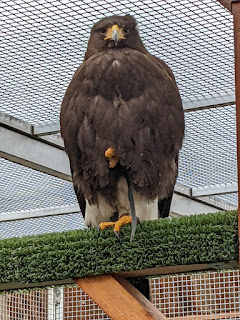
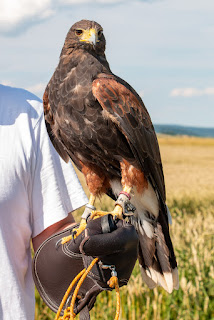
This is her usual stern expression.

She’s always looking around for crows and magpies when she’s on my glove. Usually to my right, in front of us, sometimes behind me. Now and then she seems to glance at me but quickly looks away again. I’ve been told and have read many times that one should not look directly at a bird of prey because they see that as a threat. Predators look directly at them, so it’s best if we don’t. Hekate isn’t too bothered by my looking at her, but I also don’t stare.

This is Aik, Hekate's smaller half-brother.
Somehow he has a softer expression than Sis.

Yesterday after the magpie flew off Hekate looked directly at me for longer than a glance. When she’s on my glove her beak – which is sharp enough to tear into a feathery crow or a tasty rabbit – is about 20 cm (7 in) from my face. Yesterday I understood why it’s better not to look directly at one’s hunting partner. In that look I read, “You do that again, Human, and I will f*ck you up.”


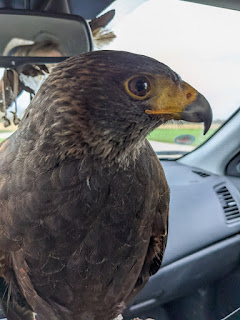
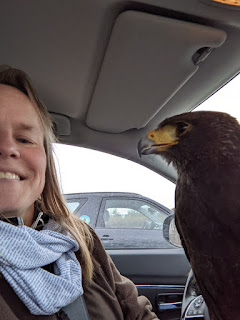
This gives an idea how close the bird is.
We're waiting in the car because it's raining.
(That's Aik again)

Hekate’s falconer assures me this happens because we’re human and make mistakes. We miss things. Hekate has better eyes than we have and doesn’t get easily distracted (except by dogs and wheelbarrows, which she hates). Hekate makes mistakes, too at times, but more often than not, it's the falconer's screw-up.

Her falconer and I switched a while after that, and at one point she sent Hekate off after two crows and a Nilgans (Egyptian goose). The crows took off early enough to escape, but the Nilgans was slower. Hekate has not really been in the mood to go after Nilgänse since an incident a year or two ago when one fended her off, and yesterday she flew in that direction but just plopped down near the goose as if to say, “Nope, not today.”

I can’t really blame her. I mean, there was my screw-up, and then when her falconer sent her off after 2 crows with a buzzard not far off, she missed the crows and the buzzard came after her! It was just a brief encounter, and the buzzard flew off when Hekate’s falconer shouted, but that couldn’t have been pleasant. Then with the Nilgans I think she was just done.

We were hawking for about 2.5 hours yesterday and came away with no Beute (loot, swag, quarry). During this entire season, which started in early September, that was only the third time we came away as tailors (Schneider). It happens. By the way, German hunters, falconers and hawkers say, when no kill was made, that they “came away as tailors.” I have no idea why, but I’ll research that and get back to you.


Friday, December 3, 2021

Drückjagd: Ausrüstung

Am Wochenende sind wir auf unserer ersten Drückjagd als Schützen. Wir waren schon viermal Treiber, und wir freuen uns auf diese neue Gelegenheit, obwohl das Wetter absolut scheiße sein wird: Regen, Wind, Kälte (na ja, nicht "Kälte" nach Wisconsin-Standard). Es könnte sicher schlimmer sein, aber wir werden nass werden.

Was bringt man mit, wenn man auf Drückjagd geht? Da habe ich Verschiedenes gehört und gelesen. Einer sagt, nimm weniger mit, einer sagt, nimm mehr mit, denn schlimmstenfalls schleppst du Einiges unbenutzt wieder zum Auto. Aber was du nicht dabei hast, hast du halt nicht. Diese Empfehlung passt mir.

Also...am wichtigsten sind natürlich

  • Jagdschein und Schießnachweis
  • Gewehr und Munition
  • Wetterangepasste Kleidung

Aber was kommt noch in den Rucksack? Zwischen Tipps von anderen Jägern und der Kenntnis, was ich schon immer bei mir brauche, habe ich eine Liste erstellt. Und wie Santa, habe ich sie zweimal gecheckt.


Eine Decke & 1-2 Handtücher: Die kleine Decke kann ich wahrscheinlich lassen, aber die Handtücher brauche ich, um meinen Sitz, meine Büchse und weiß der Geier noch was zu trocknen.

Extra Handschuhe & Handwärmer: Wenn mein erstes Paar durchnässt ist, habe ich das nächste Paar bereit.

Gehörschutz: Ich schieße nicht ohne ihn.

Reisepass/Personalausweis: Wir kennen den Jagdpächter persönlich, aber in Deutschland gibt es eine Ausweispflicht.

Digitales COVID-Zertifikat der EU: Falls mein Handy oder die CovPass App nicht funktioniert, habe ich meinen Impfnachweis auch auf Papier.

€20: Jeder Schütze ohne jagdtauglichen Hund bezahlt €20 für den Unkostenbeitrag für Treiber, Hunde und Verpflegung. Wir waren schon Treiber. Wir wissen, was sie einbringen!

Plastikbeutel/Ziplock: Weil mein Rucksack nicht Wasserfest ist, tue ich alle meine Papiere da rein (Jagdschein, Reisepass, Impfnachweis, €20).

Taschentücher: Die habe ich sowieso immer dabei. Und Schnupfen, wenn man leise sein will passt nicht.

Extra signalfarbene Mütze und Kappe: Es wird nicht lange dauern, bis ich diese brauche, weil die ersten durchnässt sind. Danke, Exondo!

Sitzkissen: Ein Kissen ist es nicht wirklich, aber ein faltbares Ding, auf dem ich sitzen kann (der Sitz wird nass sein).

Messer: Man geht nicht ohne Messer auf die Jagd.

Ohnmachtssnickers, Müsliriegel, String Cheese, Wasser: Weil ich vorher nichts essen kann (hab einen nervösen Magen), muss ich etwas zum Vespern dabei haben.

Halsbonbons und Traubenzucker: Gegen Husten, trockenen Hals und Unterzuckerung. In Saarland habe ich gelernt, es dauert ca. 20 Minuten, um ein Halsbonbon zu lutschen. 

Fernglas: Braucht man, z.B. um das Wild anzusprechen.

Notizblock und Kuli: Für Notizen zum Schuss, Anschuss, Uhrzeit, usw. Wirst du dich nach "Hahn in Ruh" an alles noch erinnern, was wichtig ist? Ich als Jungjägerin verlasse ich mich nicht darauf.

Regenponcho: Wenn ich weiß, es wird trocken sein, dann brauche ich das nicht. Aber Regen ist dieses Wochenende angesagt, das ist sicher.

Extra Halstuch: Weil ich noch genug Platz habe.

Nasen-Mund-Schutz/FFP2 Maske: Weil es 2021 ist und wir noch mit Corona kämpfen, braucht man immer eine FFP2 Maske. Wir müssen sie beim Anmelden und zum Schluss tragen - wenn wir zusammen mit anderen sind, auch wenn wir Abstand halten.

UPDATE: Kabelbinder!! Hätten wir etwas geschossen, hätten wir unsere Marke mit einem Kabelbinder am Bein des Stückes festmachen müssen.

Andreas Bach (in Wild und Hund, "der bewegte Schuss") schreibt, "Viel Ausrüstung wird oft belächelt." Das ist mir egal. Frag aber nicht, was ich alles noch im Auto habe! 😉  Das Zeug kommt nicht mit auf dem Drückjagdstand, aber ich weiß, dass ich nach der Jagd auch alles habe, was ich vielleicht brauche (inklusive einen komplett Wechsel meiner Kleidung!). Nach der Jagd werde ich wissen, was überflüssig war.


Warum jagen wir? Damit wir gut essen können. Wir wollen unser Weihnachtsreh erlegen, weil Rehrücken mit Kräuternusskruste zu Weihnachten schon seit drei Jahren bei uns Tradition ist.


Weidmannsheil!!