Showing posts with label culture. Show all posts

Thursday, May 16, 2024

Stolpersteine in Stuttgart

Ein Stein. Ein Name. Ein Mensch.


A few days ago I read in our local paper that the artist Gunter Demnig himself would be in Stuttgart today to lay eleven Stolpersteine in several different locations. At one of those locations, Uhlandstraße 14A, he would be laying six Stolpersteine, two of which were sponsored by students at the Stuttgart High School, an American school on Patch Barracks.

Since hearing about Demnig’s art initiative quite a few years ago, I have looked for the Stolpersteine and told guests and student groups about them. Biographical information is available online about most of the people commemorated by the Stolpersteine, as is fitting to Demnig’s goal that the victims of the Nazi regime not be forgotten. “One stone. One name. One person.”


I arrived early, as I am wont to do, and just as the organizer (Frau Bouché from the Initiative Stolpersteine Stuttgart) started to ask if I was part of the group expected, the American students arrived. I snapped some photos from the background and let their chaperone know who I was, that I was there privately and wouldn’t post photos of the students anywhere. However I gave her my card and said if she emails me, I can send her any photos I take.

Frau Bouché spoke to the students a bit and told them Demnig would probably dash off quickly after laying the stones because he had more to do after these. I told the chaperone I am not shy about asking for certain photos in situations like this, and if I saw an opportunity I would ask Demnig to pose for a photo with the students.

I knew Demnig as soon as he arrived, as he is quite recognizable. He briefly greeted a few people and got to work. 

Gunter Demnig


The Stolpersteine Demnig laid at this spot were for Isak and Johanna Falk, their nearly-adult children Fritz and Carry, and Meier Rosenstein and his daughter Frieda Süß-Schülein.

After he finished he packed up his tools and buckets and I sidled up to him and asked if he’d pose with the American students because they were the sponsors of the two Stolpersteine for the Falk children. He graciously agreed and I got several nice photos. I can’t post them because of obvious reasons and because I told the chaperone I would not.

After Demnig drove off, the ceremony began in which Frau Bouché told us in English about the six individuals and their story. One of the students spoke very good German, welcoming those gathered and introducing her group, and another student read a poem she’d written for the occasion. 

The last thing Frau Bouché told us was that in 1943 her parents and older sister had moved into this very apartment where the Falk family had lived before being forced to leave this home in 1939 to take up positions in a Jewish nursing home near Heilbronn. She said her mother knew a Jewish family had lived there and it saddened her, but they did not ask what had happened to them. It clearly meant something special to Frau Bouché that she has been able to honor the Falk family in this way.


For more information about Gunther Demnig's Stolperstein initiative, click on the links above or here. To learn the stories of the people named on Stolpersteine in your area or ones you come across on your travels, google the person's name along with the word "Stolperstein." It may also help to add the name of the town in which the Stolperstein is found.


Stolpersteine continue to be laid in communities across 21 countries in Europe. It costs €132 to sponsor a stone, which is usually placed in front of the individual's last known residence. 

The 100,000th Stolperstein was laid in 2023.


Tuesday, October 25, 2022

Shop Local: Poultry Farm Shop

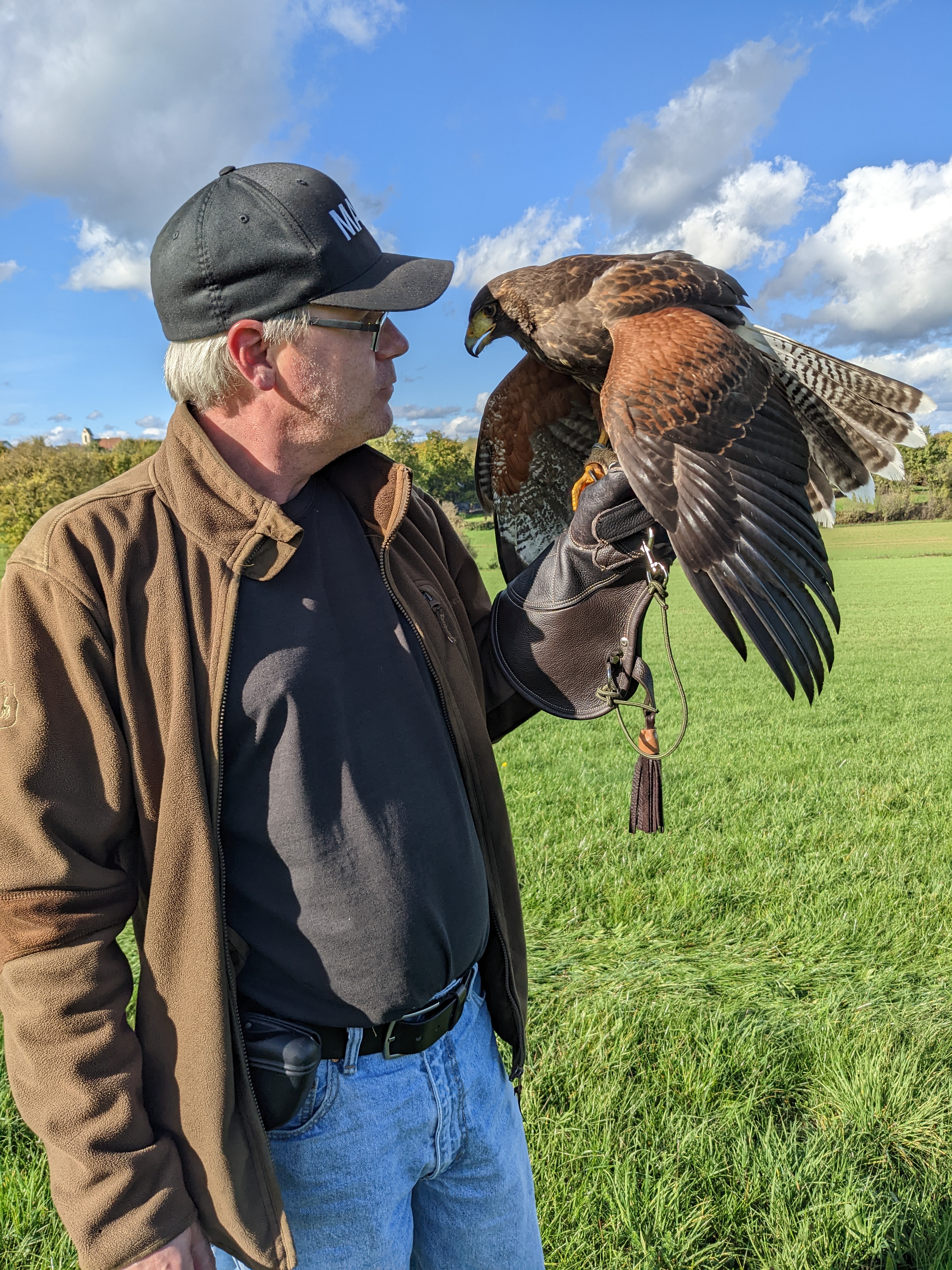
This blog post combines two of my favorite things: Falconry and shopping in local farm shops!

It's perhaps not a post for vegetarians, but Kaya is not one of those and neither are we.

Our mentor showed me this farm shop in Neustetten, a tiny town about 18 km / 20 minutes from home. The big grocery store is just four minutes away by car. Is the drive worth it, with gas prices so high? 

ABSOLUTELY!!  (especially with our electric car...)


This is the shop connected to a chicken farm, and our mentor told us they slaughter on Mondays, which means on Tuesdays they have fresh chicken and chicken parts for sale. So whenever we're running low on tidbits for Kaya's training, I make a drive here on Tuesday morning. I buy two packs of Hühnermägen (chicken stomachs) and today I also picked up Hühnerherzen (chicken hearts).

Gross, you think? I beg your pardon! This is Swabia, where generations ago many people were poor. Nothing - or very little - from the animal, be it cow, pig or chicken, was wasted, and Innereien (offal, giblets) were turned into delicacies that are still enjoyed today. Ok, not by me, but when I told my Schwiegermutter what I'd bought this morning, she did not know if it was for Kaya or for us. A family friend has cooked Hühnermägen and according to her, M liked them when he was younger!

In fact I plan to get there within an hour of the shop opening, because I want to make sure they're not sold out of the giblets. Because the demand is perhaps not SO high, these bits are also not expensive. From one package I can get portions for 12 training sessions, and it only costs €2,50.

Hühnermägen rinsed and ready to be cut up for tidbits.
It's just meat, really.

This shop is not just about chickens. They sell fruits, vegetables, spices, fresh herbs, plants, flour, oil, canned and jarred goods, nuts, noodles, and today I saw traditional German Christmas treats like Zimtsterne, Lebkuchen and Schoko-Vanillekipferl. 


Later I spent half an hour cutting one package of Hühnermägen into tidbit pieces for training, and when we trained Kaya this afternoon she had fresh (not frozen-thawed) tidbits, which she must have enjoyed even more than usual.

At the end of training; she's still manteling
to let M know she'd happily take some more.

These local farm shops are one of the many reasons I love living where we do - basically out in the countryside. We will keep doing what we can to support these shops even though they're not as convenient as the big stores where all the goods arrive on delivery trucks from who-knows-where.

I bought more today than what Kaya needs, of course. I brought home some Hähnchenkeulen (drumsticks) to make Jamie Oliver's Hit-and-Run-Chicken, along with all the vegetables that go in it. Bananas, raspberries, and shelled walnuts topped off the items I snatched up. 

Their special for this week reflects another southern German tradition:


November 1st is Allerheiligen (All Saints' Day) and November 2nd is All Souls' Day. Allerheiligen is a stiller Feiertag here in the south, which means stores, schools and businesses are closed and people visit their relatives' graves, decorate them for the season, and light candles. The shop is offering Grabschmuck, or decorations and flowers most fitting for the pre-winter planting.

On the way home I stopped at another favorite family-owned shop - the bakery in our neighboring town. Fresh bread, rolls, croissants, and a sweet treat. Those were all for us humans, though. Kaya is all about the meat.


I wish you a happy end of October!


Monday, March 4, 2019

Manners and Etiquette: Knigge Part 1

In German, Knigge represents proper social behavior one should practice in pleasant company. The term comes from the man who first published in Germany a manual for etiquette in 1788: Adolf Freiherr von Knigge. His work was called Über den Umgang mit Menschen (On Interaction with People). I found this topic interesting enough to buy this book a few months ago, being mainly curious how German Knigge would compare to the way I was brought up.


In this weekend's newspaper were two articles about Knigge, including an interview with Clemens Graf von Hoyos, chairperson of the 300-member Deutsche-Knigge-Gesellschaft (German-Etiquette-Society). Thanks to their society German Knigge also provides guidelines for things Freiherr Knigge could not have imagined in 1788 such as online and Smartphone Knigge, escalator use, and travel/airplane etiquette.

Ok, despite Elke Stadler, Knigge-Trainerin, ending her article by saying that we common folk should not go about instructing others (especially publicly) on which rules they are breaking and how they should behave, I thought I'd share with my fair readers what I've learned!

Keep in mind that etiquette rules are different from country to country, and at home we may all do as we damn well please. But to avoid the problems Julia Roberts faced in "Pretty Woman" when out in higher society than we're used to, Knigge tips and guidelines can be helpful.

Things to Avoid (??)

"Guten Appetit"

Wait, what?!? It is ingrained in every German's psyche not to dig into a plate of food without waiting for someone - parents, waitress, table companion - to say "Guten Appetit"! They and I will go on wishing a "Guten Appetit" no matter what Frau Stadler says. The reasoning behind why this is sketchy is what caught my attention. In earlier times it was a serious faux pas to say this to nobles because it called the quality of the food and kitchen staff into question! There was no need to wish wealthy people a "good appetite" because that came from the delicious and aromatic victuals all by itself. 

Commoners, however, were forced to eat whatever they could find or buy with their meager funds, and their food was often near-to rotting scraps and leftovers. The phrase "Guten Appetit" amounted to: "I hope your appetite is strong enough to force that food down." Now, even in that context "Guten Appetit" fits well as a Swabian compliment, so in our house we will continue to use it.

"Mahlzeit"

This is a common phrase coworkers or bosses say as they leave the office or meeting for their lunch break. There is no equivalent in English, although it translates to "meal time." The closest in English would be "Time to eat!"

So what's wrong with this one? This time the explanation is very modern, although the origin of the phrase comes from monasteries and convents. Monks and nuns usually kept a very tight routine and were directed about by church bells and chimes because of course they didn't have watches or Smartphones to tell them what time it was. "Mahlzeit" was a reminder that it was now time to eat pray and then eat. Obviously nowadays as we are surrounded by clocks, computers, Smartwatches, mobile phones, etc., we do not need to go about telling other people what time it is or announcing our intentions to go check out what's in the Kantine.

Many people these days are trying to pay better attention to their health, fitness, and eating habits. Quite a few of your coworkers may choose to use their lunch noon break to go for a walk, meditate, work out, or take a power-nap, and therefore reminding them of a meal is rather out of place for the same reason you wouldn't tell someone "Enjoy the donuts I brought!" when you know he is on a diet or fasting for any reason.

We should probably stop posting food pictures, too.

Our Knigge-Trainerin recommends saying "Guten Mittag" or "Angenehme Mittagspause" instead, wishing your colleague a "good noon" or "pleasant noon break".

Anstoßen mit Gläsern

This is clinking glasses with each other before taking your first sip of wine, beer, etc. We're back to the Middle Ages for this one.

We're doing this wrong anyway -
we're supposed to look at each other, not the camera.
And M was trying not to spill and waste the beer.
When enemy knights found themselves face-to-face unexpectedly, there were often subtle exchanges that amounted to threats - an indication one wanted to fight or even kill the other. When they banged their mugs together, the intent was that some of the brew would slosh over into the adversary's mug. When both drank - holding eye contact, of course! - it was an assurance that neither beverage was poisoned.

These days our glasses are more delicate than back then, and there is a good chance a too-enthusiastic bump will cause damage. Since we generally no longer need to prove to others that we haven't poisoned their drinks, it is better nowadays for the group to lift their glasses, make direct eye contact with everyone round the table, and say a collective "Zum Wohl!"

"Gesundheit!"

Oh, come on! I was taught saying this to a poor sap who sneezed is politeness!! I actually first heard about a movement to get people to stop saying this while still in the US. There the idea was that we should not draw attention to someone else's bodily functions. We don't say anything when the bloke next to us coughs or farts, after all...

The Knigge-Trainerin says allergy-sufferers will sing this one from rooftops! The idea is to not publicly point out someone else's weakness. By saying "Gesundheit!" every time someone sneezes, we are bringing unnecessary attention to an uncontrollable reflex, which the poor chap is all too aware of. During allergy season or when someone is sick (in which case she should rather keep her germs at home), it is a nuisance to have someone respond every time the sufferer sneezes!


Just for fun, I'm going to list a few no-noes at the table from the Knigge book pictured above which I had not ever really thought about but now know go against German Knigge, at least when adults do them. I would venture to guess many/most of my Landsleute don't give a thought to any of the following either, except those in high society.

One should not...
  • take a drink before the host/ess has given a toast.
  • cut spaghetti noodles with a knife.
  • cut meat (such as meat loaf) with a fork.
  • salt or pepper the food before tasting it.
  • park your cutlery resting on your plate with the handle on the table.
  • hold your wine glass above the stem.
  • blow on the food to cool it.

I'm jetting off to visit my kids this week (with apologies to Greta and Co.), and when I return I'll surely have Part 2 of this post ready - concerning travel Knigge. Assuming I don't end up in the slammer for drubbing the twits sitting near me, of course.


Tuesday, February 26, 2019

Fasnet and the Jugendschutz

Fasnet is the Swabian word for Fasching/Karnival, and this weekend is high season for shenanigans. I always intend to research the historical traditions behind this springtime custom of chasing away the demons of winter, but so far I haven't got around to it. Seeing as the whole business involves a lot of people, a lot of drinking, and masks, it's just not my scene.


Bildechinger Blockstrecker
This Thursday is Schmotziger, which I've learned doesn't really mean "Dirty Thursday" (though that fits in a way, too) but rather probably comes from the word "Schmalz," which is fat or lard. Around this time it was - and still is - popular to eat sweet and fatty foods to get ready for the fasting time of Lent.

Fasnetsküchle
"little Fasching cakes"
Enthusiasts say Fasnet or Fasching is not just about getting drunk, and I'll believe that. However, this week's Real ad brochure begins with beer, more beer, Jack Daniels and Coke in a can, Schnaps, vodka, Sekt (sparkling wine), beer glasses, glass boots, and a beer barrel carousel. The seasonal section, closest to the entrance and the cash registers, is full of alcohol and costumes.


This week's Blättle (local newsletter) is full of info about where to find the parades and parties as well as reminders to be sensible and clean up after your damn selves. Vergebens (all for nothing). It generally takes a good week for all the filth in the streets, parks, and public areas to be cleaned up by city workers or to blow away. Broken bottles, crushed cans, empty beer cases, confetti and candy wrappers from parades...

There are also two articles in the Blättle about Jugendshutz (protection of youth), which involves laws but mainly protecting young people against their own dumbass decisions. We are reminded:

  • Children under 16 may not buy alcohol.
  • Children between 16 and 18 may buy beer, wine, or Sekt, but no hard liquor.
  • As of age 18 young people can buy any alcohol.
  • Children between 14 and 16 who are in the company of their parents or guardians may consume alcohol, but not Branntwein (hard liquor - the alcohol content is too high).
  • Children 16 and older are allowed in pubs even without parents until midnight.

Several of the stores in our town are participating voluntarily in a program called the "Rottweiler Idee" (Rottweil* idea) which hopes to dimish the incidents of young people drinking to the point of alcohol poisoning, which I applaud. At the same time, I realize that a wee bit of planning ahead (and most Germans are masters at this) circumvents these noble efforts. According to the article, local incidents requiring police intervention during Fasnet have decreased since the Rottweiler Idee was implemented.

*Rottweil is the Swabian hightown of Fasnet. Köln holds this fame to the north, but down here Rottweil is the place to be to celebrate the most traditional of Fasnet gatherings, parties, and so on.

What the stores in the vicinity of the Bahnhof have agreed to is not selling hard liquor to persons under the age of 25 on three upcoming days of drunken foolery: Schmotziger, Fasnetssamstag (Saturday) and Fasnetsmontag (Rosenmontag - the Monday that is the highlight of the Fasnet madness fun). Sunday doesn't need to be on the list because all stores are closed every Sunday.

Our town has been doing this since 2014. The store M and I use most often, Real, is not participating, unfortunately. This store is not near the Bahnhof, but its neighbor Norma is participating and I wish Real would, too. The kids can still buy beer, wine, and Sekt and can do plenty damage to themselves with those, but limiting hard liquor is at least something.

Not only will Real continue to sell alcohol to everyone over 18,
but plenty of the offerings are also on sale through Saturday.
I'm not a teetotaler and don't judge people for including alcohol as part of a celebration of whatever kind. I even think the U.S.'s drinking age of 21 is a bit silly when kids at 18 can serve in the army. Alcohol is part of German culture, and having a glass of wine or beer with lunch - even at a business meeting - isn't unusual. I just applaud the idea of (voluntarily!) making it as difficult as possible for young people to binge drink themselves into a coma or worse. The cut-off age of 25 is probably bit harsh, but I don't have a problem with it during the craziest days of Fasnet. The scariest thing is that there is surely plenty of drinking and driving during these days, and since Germans can drive as of age 18 but lack experience and judgement, the Rottweiler Idee could be intended to address this danger as well as to limit the ability of already wasted young people from buying even more hard liquor.

Whatever your plans for the days of Fasnet, Fastnet, Fasching, or Karnival, stay safe and make good choices! And for mercy's sake, don't drink and drive!!!


Friday, November 3, 2017

Could you become a German??

I don't put my birthday on social media because I don't want anyone wishing me a happy one just because a machine told him or her to do so. However, I turned 49 this year, and what was one thing on my wish list? This game...


This board game is based on the 330 questions that make up the Einbürgerungstest, or German citizenship test. Each card has one of the actual questions from the test, the four multi-guess possible answers, and the correct answer. Players roll the die and move their little Spielfigur around the board, answering a question on each space they land on. When a player answers a question correctly, he keeps the card. The first player to collect 17 cards wins.

Why 17? For the actual Einbürgerungstest, takers need to answer 33 questions (30 about Germany in general and 3 about the state in which they are taking the test) and get at least 17 correct. That's 51%. 59% was a failing grade in the school I taught at in Wisconsin. Happily, the majority of my students have scored very well on the test - most 90% and higher.

There are special spaces on the game board, indicated by several symbols.

  • two Bundesadler = das "Bonusfeld" - the player landing on this space gets to answer two questions in a row.

  • three hearts = das "Nachbarschaftsfeld" - the player landing here can ask her neighbor for help if she doesn't know the answer. Awkward when playing with just two people, one of whom is holding the card with the answer.

  • a four-leaf clover = das "Glücksfeld" - one correct answer yields two cards.

  • an airplane = das "Reisefeld" - "Friends decided to take a last-minute vacation. The player [landing here] unfortunately has no visa and therefore can't join them. Sit out one turn."

  • an alarm clock = das "zu spät" Feld - the player landing here showed up late for the Einbürgerungstest. He sits out one turn."

  • Lady Justice = das "Gerichtsfeld" - the player who lands here has defied the law. She must give up one of her cards.

  • a circle with a red X = das "Wahlfeld" - it's election time in Germany! Unfortunately the player landing here does not have citizenship and therefore cannot vote. He sits out one round.

Since November 1st is a holiday in Germany and M didn't have to go to the office, he agreed to play a round of this game with me that morning. It could definitely be fun, but since both of us knew all the answers that came up, I guess it was a little dull.


What livened things up was that I kept landing on the special spaces - and NOT the good ones! In no time at all M had amassed seven cards, and I had only two! After I grumbled good-naturedly (I'm possibly the least competitive person in the world), with my very next roll I landed on the Gerichtsfeld and had to give up one of them! I protested when I landed on the "zu spät" Feld, because I would NEVER be late for something as important as a test! (In truth, I would rather be an hour early than five minutes late to anything. I just find a quiet spot and read the book I always have with me.) But how appropriate for a German game that a player gets punished for the very idea of being late.

In the end we actually both counted up 18 cards, but M had got there first.

I had to laugh every time M said, "Why the hell does a foreigner need to know that?!" For instance, since which year have we been paying in cash with the Euro? What possible need could there be for a Syrian refugee or an immigrant from Scotland to know that? It's enough to know that we pay in Euros now. Who cares "since when"?

Here are two more: What is a Gerichtschöffe and who can be one? Well, that's a special assistant to a judge who needs to decide on a case. It's kind of like a jury member or volunteer judge, but there are only two of them who listen to the evidence and give their inexpert input. Who can be one? Not a foreigner, unless she is naturalized and speaks/understands German at the level of a native speaker.

Having taught the Orientierungskurs twice now - and my third course will start in December - I am very familiar with the 330 questions and answers. And I'd like to suggest the gang of sadists who came up with those questions be tarred and feathered. Some day I'm going to go through those cards and make a pile of questions I consider important enough that someone applying for citizenship should know just to see how many are cruel. The writers of the test should each receive three lashes for every unnecessary question.

I like the fact that there's a game available to practice for this test, and it could be a fun party game for a mixed crowd of immigrants who have taken the Orientierungskurs and Germans. Too bad we don't have parties. Obviously I plan to use it in my class.

In other news, I'm nearly wetting myself over the new pile of thick books I have to read.


My head is spinning because I don't know which one to start with. To make matters worse, I am smack dab in the middle of a 600-page book about Katherine of Aragon, and this would be a dumb time to stop in order to start on a different really long book - or two! Dan and Ken should really plan this better and publish their new novels six months apart and when I have time to read them. Poor me with my First World problems...

I just found a box of civics questions for the US citizenship test. I might put that on my Christmas wish list! I'm a sucker for trivia games.


Have you found any good trivia games lately? 
Do you enjoy playing games that show you how much you still have to learn?!?


Sunday, January 29, 2017

Loving Southern Germany 5: Castle Ruins

Most tourists who come to Germany visit the well-known castles and palaces - Neuschwanstein, Linderhof, Nymphenburg in München, Charlottenburg in Berlin... Many visit castles along the Rhein as well. They are expensive to visit, but it's nice to see how the upper crust lived many years ago. I don't begrudge anyone wanting to see these castles and palaces, but I am glad I will not ever again need to visit the over-rated Neuschwanstein, having taken enough student groups there over the years.


Neuschwanstein, Bavaria
This palace isn't even very old - it was built after the American Civil War ended!

Nymphenburg, München, Bavaria

Pfalzgrafenstein, on the Rhein, Rheinland-Pfalz
Personally I prefer the castle and fortress ruins - the more rustic and ruined, the better. They each have a history, sometimes steeped in mystery, leaving visitors to use their imaginations.

Many ruins are free-of-charge, and others charge a nominal fee to help with upkeep and maintenance. And they're all over, at least in southern Germany.

Within walking distance of our home not long after I moved here, we found Ruine Eutingen. To learn about the more remote ruins, you need to know German because they are not tourist attractions and little or no information is available in English. This Burg (fortress) was built in the second half of the 13th century and was the seat of the Lords of Eutingen. It was destroyed by Graf von Hohenberg in 1350 but eventually rebuilt, changed hands a number of times over the centuries, and abandoned and sold off in 1818. Today one can find the remnants of a tower and wall, a cellar vault, rounded window arches, and Schießscharten (arrow slits).


This turned out to be a nice afternoon's walk and adventure on my birthday a few years ago, because although we knew about where it was, we had to search and backtrack a few times before we found it hidden on a hill among the trees.

When fellow blogger Adventures of La Mari and I decided to meet, we chose the ruins at Hohentwiel near Singen. Our husbands and their pug Abner joined us to explore the ruins. This one is well-enough known that info is available in English. The first castle on this site was built in 914 and first served as the seat of Swabian dukes.


My Schwiegermutter enjoys exploring ruins as much as I do, and we made an excursion together to Klosterruine Hirsau, near Calw. The origins of the monastery go back to 830, and in 1091 the large church was built. These ruins are an architect's delight, with clear and preserved examples of Romanesque and High Gothic windows and elements.


Just right of center are the rounded arches of Romanesque style windows.
Just left of center in reddish brick you see the pointy Gothic arches of the Kreuzgang (cloister).
Marienkapelle in the background.
Some might see all this as piles of rocks, but I see Germany's romantic and turbulent past. And part of the beauty of southwestern Germany for me is that whenever I have time, I can check out a new one or visit an old favorite. They are easily accessible by train and bus, and an extra bonus is often a lengthy walk or climb to get there from the station, which is about the only exercise I ever get.

Nagold is a beautiful little town not far from us, and the ruins on the hill above town are worth the forest climb.

watch tower and oven of Hohennagold

cemetery at the Remigiuskirche with fortress ruins in the background
Although I haven't visited them yet, we did pass below the ruins of Hohenurach on a walk to the Urach waterfall on a lovely autumn day. I'd rather wait until the renovations are finished anyway.


With the exception of Hohentwiel, none of the ruins I've mentioned charge an entrance fee. Even Hohentwiel costs only €4,50, while Neuschwanstein will set you back €13, which doesn't include all the tourist crap Gedöns bits and bobs you'll be tempted to buy in the shop.

Let that stand as the fifth thing I love about living here in southwestern Germany, though there are plenty of ruins in other parts of the country as well.

For more on this thread, see:
  Beautiful Towns
  Landscape
  Food
  Holidays
and
  Wegkreuze


Wednesday, January 6, 2016

Dreikönigstag 20*C+M+B+16

For long-time readers, this is an old post slightly edited and updated for this year with new photos taken moments ago.

Today is Dreikönigstag, Epiphany, which signals the end of the Christmas holidays here in Germany. Tomorrow regular work resumes for those who didn't already have to be back earlier this week, though classes don't resume in Baden-Württemberg schools until Monday.  In the States, school and work resumed on Jan. 4th - as soon after New Year's Day as possible.

On Dreikönigstag here in southern Germany, groups of children called Sternsinger go from house to house dressed in kingly costumes and carrying a lighted star. They sing a song, recite a poem about the three kings, write a blessing on the door frame, and collect a donation for a charity.  People they visit may also give them a treat - some chocolate, candy, etc. - to give them energy to carry on through the day. In our little village several groups of children are deployed with their adult chaperones to every house. Most people are home to greet them because today is a stiller Feiertag (holiday) in Baden-Württemberg.


This year's group was adorable! They sang very well and had their lines memorized, and they seemed to appreciate our donation and the nibblies.


The blessing they write on the door frame is (this year) 20*C+M+B+16.  Each piece of the blessing has a meaning.

    20...16 is the current year.
    The * represents the Star of Bethlehem.
    C M B stands for Christus Mansionem Benedicat** ("Christ Bless this House" in Latin)
    The three crosses represent the trinity.

**It is a common misconception that the C M B stands for the initials of the names of the three kings, which coincidentally are Casper, Melchior, and Balthazar.

The blessing stays on the door until the next Dreikönigstag, when the entire blessing is wiped off and rewritten for the new year.


I truly love this tradition, and I got giddy when I heard their footsteps on the front porch! It brings closure to the Christmas season in a really nice way. If I could send one holiday tradition to America, I'd send this one.

After the Sternsinger leave, it's time to take down Christmas. The decorations go back into their boxes, the tree branches get cut off and placed over garden plants to protect them against the cold, the tree trunk gets chopped up and put in the garage to use for firewood in 2 years when it's dry (because nothing gets wasted or thrown out in Swabia!), and the nativity scene gets packed away until next December. This year we're actually going to wait a bit; our neighbors told us just the other day and my Schwiegermutter confirmed it that the Catholic tradition is to wait until Mariä Lichtmess (Candlemas - February 2nd) to take down Christmas!

It was a lovely Advent and Christmas season, and I am always a little sad to pack up the decorations. I so enjoy the lights on the outside of the house, our lighted Christmas star and tree, and the general cheer of Christmas decorations.

I've enjoyed reading other bloggers' end-of-year and/or New Year's posts, and although I probably won't write one of those since I'm too much a realist for resolutions or personal goals, I should be able to come up with something interesting to write about in the next few weeks.


Monday, December 21, 2015

The Storm before the Calm

It's Christmas week! Although it's warm like autumn here with no snow in sight - which is totally fine by me! - we're making final preparations for our small Christmas celebration. The tree is up and decorated (American tradition - do it early so you can enjoy it longer!), the Advent wreath's fourth candle was lit last night, the nativity scene is arranged though Baby Jesus is in the drawer with the remote controls until Christmas Eve (why that drawer? So we don't forget where we stashed Him), the meat has been ordered, the outside icicle lights are up and on a timer to turn on every morning and evening, most of the presents are wrapped, and the stockings are hung.


I believe I have all the groceries we need for the next two weeks except for what I'll get from our vegetable guy tomorrow evening and the meat I'll pick up at the butcher. But today I did have to go to the grocery store one last time for a few additional things.

What a ZOO!!!

Monday is always somewhat busy at the store because it's closed every Sunday and people are getting ready for the next week. But today was even worse - I barely found a parking space - because of what's coming at the end of the week.

On Thursday, Christmas Eve, the store is open until 14:00 (2:00 pm). It will re-open the following Monday. That's right - the grocery store is closed on Christmas Day, Boxing Day (the 2nd Day of Christmas), and on the 27th because stores are always closed on Sundays here.

I've said it before - I really like it that the stores are closed and even the employees - all the employees - can spend the holiday time with their families. Sure, it can be inconvenient for us, like last year when I forgot to buy the pork roast that was to be dinner on New Year's Day and only realized this 20 minutes after the stores closed on New Year's Eve. M foraged around in the freezer and found four duck legs, and we had a wonderful meal anyway - trying out a new recipe besides!

the Barbarie Entenkeule that should have been a roast

Everyone has to plan ahead around the holidays and stock up on the things one can't do without, like coffee, milk, bread... I've made a list and checked it thrice, and this morning I went to the store along with the entire rest of the community. Shopping carts everywhere, grannies and their mates trudging along very, very slowly, younger people half pushing, half leaning on their carts while diddling with their cell phones, temporarily abandoned carts blocking shelves everywhere, employees stocking shelves and pulling huge carts around the store dodging customers, neighbors stopping in the middle of the aisles to chat, a line at the butcher, a line at the cheese counter, a line at the bakery, a line at the produce scales, and a long line at the checkout. Ugh. The only way to keep your sanity is to be patient and appear friendly. Nailed it.

This is so last year - this year we have only balls on the tree and no snow.
Although the stores will be crazy tomorrow and Wednesday as well, as of mid-day on Thursday all will calm down and we'll enjoy the quiet. Three and a half days of no shopping, no fighting crowds exchanging unwanted gifts, no dashing about for after-Christmas sales. Just quiet time with family. Walks in the valley, perhaps a snowless drive into the Black Forest, rounds of Trivial Pursuit, holiday films, reflecting on the past year and planning for next, and relaxing. The Germans really know how to do Christmas!

As for us, it will be just M, my Schwiegermutter, and me this year. My parents and kids have some grand plans in the U.S. (for instance driving from Wisconsin to Disney World and back over a week). We'll make Raclette on Christmas Eve, Lamb Stew on Christmas Day, Fondue (with soup, not oil!) on New Year's Eve, and on the other days Cordon Bleu, Shepherd's Pie, Ostpreußische Schusterpastete, and grilled pork (Schweinehals) with Bratkartoffeln.

Oh jeez...there I am going on about food again.

I wish you a very Merry Christmas and a good slide into the New Year! May 2016 bring peace.