Thursday, June 20, 2019

The Broom Pedlar

I was sitting in my home office today with the front door wide open to let in the cool morning air (the office is right next to the front door). This is not unusual for me, and sometimes the local wildlife wanders in. The neighbor’s cat, bees, dragonflies, luckily no birds yet…

Today I heard some awkward rustling on the porch and then the doorbell. We sometimes get beggars who come with laminated notes written in sketchy German and English, and sometimes they try to block the door as you shut it, so I braced myself. I don’t like people in general and do not appreciate being interrupted by spontaneous doorbell-ringers, so my mood was abruptly “Leave me the hell alone!” 

But…

There was a harmless-looking man standing there with brushes and brooms. For whatever reason I put on my vacuous American smile and said hello. He opened his mouth and out came something that might have been dialect, and might have been Klingon. I didn’t understand a word. I interrupted in German and started to say, “I’m sorry, but I don’t understand…” He said, “Oh, you don’t understand German?” “No, I understand German just fine. Just not dialect.” 

Cutting to the end, he showed me his brushes and brooms, and as I was saying, “I’m sorry, we have everything we nee….wait. What’s that you have there?!” 

 It’s a long-handled extendable cobweb brush made of goat hair! That’s probably a total lie, but it’s soft as hell. 


SHUT UP AND TAKE MY MONEY!!! 

I paid him his asking price (€30) because I'm hopeless at haggling. After I closed the door and ran my fingers through the delciously soft brush a few times, I went after the damn cobwebs in the office that I haven’t been able to reach and have been driving me nuts for weeks, and then I headed into the living room, the guestroom, the sunroom... I LOVE this thing!

Ya know, sometimes it’s the little things that make an expat’s day!


P.S. I posted this little story in an expat group, and some suggested it's just a ceiling fan dusting brush. Well, Mr. Dialect didn't mention ceiling fans - only cobwebs. That might be because Germans don't generally have ceiling fans in their homes. The breeze makes them sick and could lead to early death. "Es zieht!"


P.S.S. When was the last time YOU had a traveling salesman at your door? I love "the old world"! :-)


Tuesday, June 11, 2019

Jagdschule Report 1

I shouldn't be taking the time to write this blog post - I should be studying. I have three weeks before Week 2 of my Jagdkurs, and after the first one, I have a little better idea what I need to do. The short version is that I need to learn in several weeks everything I didn't learn (about animals, plants, biology, weaponry...) growing up and going to school in Wisconsin.

For any anti-hunters who might be reading this, this journey for me is not about hunting. I cannot imagine a future in which I ever get up at crazy-o-clock in the morning, grab my gun, and go shoot something (and btw, that is so not the way Germans go hunting). I am in no way against hunting - I love meat including venison, wild boar, and some fowl. I just wouldn't trust myself to do it right - Waidgerecht. Besides, I'm going for my Jagdschein because I want to be a Falknerin and help rehabilitate and release injured or sick birds of prey, not so I can hunt.

This is about facing a daunting challenge in a foreign language.

This is the Landesjagdschule Dornsberg
near Eigeltingen
the upper foyer with cabinet full of Präparate,
most of which I will need to be able to identify
and speak intelligently about
our classroom
After six days of class - 8:00am to 18:00 (6:00pm) from Monday to Saturday with several breaks here and there - I can honestly say I have never in my life faced a bigger challenge than this. I've raised two kids, but the pain and horror of actual childbirth was over relatively quickly, I did it all in my native language, and there was no three-part test to pass at the end. I moved overseas to begin life as an expat/immigrant, but that was a piece of cake, in part because I could already speak some German. Professionally I have been a teacher, but that came pretty easy to me also and serious challenges were short-lived.

So yeah, the number of times I wondered during that first week "What the actual hell am I doing here?!?!?" was more frequent than I wish it had been.

I was warned. People told me this is no easy thing. And it shouldn't be! There is a lot of Verantwortung - responsibility - with hunting. To prepare for the test there's a lot of reading, a lot of memorizing, and a lot of learning to do. IN GERMAN. I would have a hard time learning this even in English, and the teachers go fast through the material! We are 14 students, and I'm the only foreigner. I wouldn't expect them to slow down just for me, and there wouldn't be time anyway.

Already on the first day, though our teacher was the school director, whom I'd met before, I found myself realizing there was much I didn't understand when it came to the content (Topic: Wildhege, or gamekeeping & forestry). Then on day two the topic was Federwild (wild fowl) with a different teacher, and I learned that there are more ducks than just the Mallard (Stockente) and more geese than the Canadian. Ok, I had read much of the corresponding book in the weeks before class started, but I hadn't started trying to really identify them. One activity was to take the various Präparate and organize them on tables according to which group they belonged to. I felt sorry for my partner. I did learn, though, and can now identify a number of the ducks. The Greifvögel (birds of prey) are less problematic for me, but we only need to know two of those.

R to L: Stockente, Reiherente, Tafelente, Pfeifente (?), Krickente
a table full of ducks (and a Graugans, if I'm not mistaken)
As of Wednesday it was "Schluss mit lustig" for me: Waffenkunde (the science/study of weapons). The teacher was impressive and answered every question my classmates threw at him without missing a beat. Would that I could have understood his answers. I suppose he spoke with a bit of an accent or dialect, but it wasn't so strong that I could blame it on that. Basically it comes down to the fact that I know next to nothing about guns, ballistic, caliber, etc. despite all my reading since Easter, so I had little prior knowledge to fall back on. I understood some of what he said when he went over something I'd read and studied, but that was a small portion of the whole.

And I was so proud of myself a few months ago when I finally got the difference between a Büchse (rifle) and a Flinte (shotgun). Idiot.

I'd been afraid of guns before starting to read about how they work - the inner mechanics. Eventually I thought my fear had developed into a respect and interest. But it turns out it is still downright panicky fear. Saturday morning was our first Schießtraining, practice shooting at clay pigeons with a Flinte.

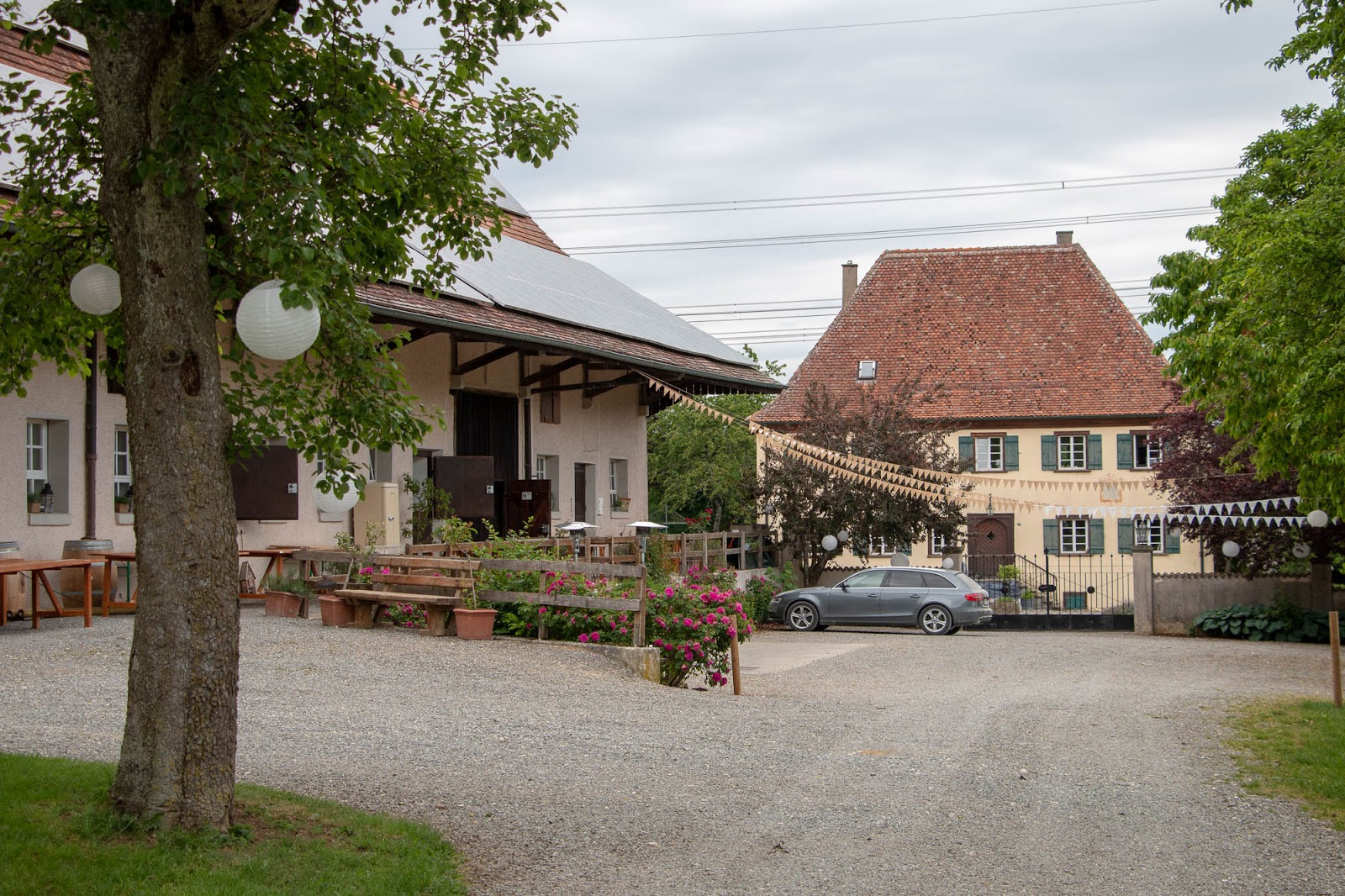
Hofgut Dornsberg, where I had a lovely room during the week


the breakfast I could unfortunately never fully enjoy
As of  Wednesday I couldn't eat more than a Brötchen/roll or two in the afternoon or evening (I have a nervous stomach even when I'm not nervous, and when I am, I can forget eating), on Friday I had to hold a real - but unloaded - gun for the first time. Our teacher wanted to check our aim, stance, and dominant eye (at least that's what I think he was doing), and I was on high alert just knowing I would have to hold and aim the gun. M asked me that night if I knew what exactly I was afraid of, but I didn't (still don't). Most likely it was not understanding and doing something wrong. By then I was well aware how much I do NOT understand, and I was thinking this is going to be extremely dangerous.

I saw a wonderful story this morning where a girl who didn't want to dive into a pool said loudly "But I'm afraid! I'm so afraid!" An old woman was swimming by, stopped, raised her fist defiantly and said, "So be afraid. And then do it anyway!" I wish I had seen that on Friday night, because that's the attitude I needed.

On Saturday morning when I opened my window, a beautiful Rotmilan flew right over the house, closer to me than I've ever seen one before. I thought briefly that could be a good omen - and a reminder of why I'm putting myself (and my instructor!) through this. Then I drove to the Schießstand (shooting range), hoping to heaven they had a WC.

My stomach was twisted all during the Waffenhandhabung (weapons handling) demonstration, although the instructor was as calm as a Zen master and spoke very clearly. Then it was time to shoot. I had fear and "I don't want to do this!" written all over my face, and one of my classmates tried to reassure me it would be fine. I had no idea how to stand, hold a gun, or aim, but I was able to load a Patrone, say "Hopp!" almost loudly enough for the guy releasing the clay pigeon to do his thing, pull the trigger, open the Kipplaufwaffe and unload the Hülse without killing anyone and without crying.

the view toward the Bodensee from my accommodation
I shot a total of 29 times, and after 14 my instructor and the Schießstandaufsicht tried to show me how to aim. I did somehow hit three of the pigeons.

One of my young classmates asked if I'd at least enjoyed it. I did not. I was only concentrating on not screwing up. The gun was heavy, despite being a Damenwaffe, and I was not at my physical strongest, having not eaten much in three days. But I did it, and my first interaction with a gun and live ammo is behind me.

???
I felt rather dejected afterwards, but once back at the school for our afternoon session on furred game, I gradually felt better. Then I drove home and felt better still. On Sunday I watched a few videos about how to stand and aim a shotgun, I read and re-read some more about guns, and M warmed up homemade Hirschgulasch (venison) for dinner.

Several times during the week I acknowledged to myself that I am in way over my head. I should have studied the books I have for several years before signing up for a class. There are just way too many words I don't know - and I mean normal German words, not just the Jägersprache. As an example, the instructor sent us home with a 50-page booklet about safety to read by the time we return. My classmates will be able to read through that during a Kaffeepause. It took me about six hours on Sunday because I had plenty of words to look up and I took notes. It's not enough this time for me to skim over words and say "Ja ja, I get the idea." I have to know this because I will be tested on it.

Still, I am looking forward to Week 2 - despite the fact that we will be going to the shooting range five days of the six. There is an impossible amount of material to learn, and if I spent every waking moment studying between now and July 1st, it would still not be enough.

So then...back to the books.

This is Markie. He was staying at the Hofgut Dornsberg
while his humans were on vacation. He was my therapy dog
during the last few days of class.
And funnily enough, I think that was the expression on my face
on Friday and Saturday morning.


Tuesday, May 21, 2019

Ah, die Deutsche Post

I've joined a few online expat groups in recent months, which has led to quite a few laughs, incredulous "No way!"'s and feelings of empathy and comraderie. I've never had much desire to connect with other expats, but I can enjoy meeting people from around the world. And since I only want to be sociable when I feel like being sociable, the online nature of these groups works well for me. I have been learning that many out there share the kinds of trials, tribulations, and triumphs that I encounter, too, as an expat.

In one of the groups I have seen quite a few grumbles about the service provided by the Deutsche Post and DHL. I've thought often enough "Gosh, I haven't had any trouble with mail or deliveries. I wonder what's going on with them. Maybe deliveries are more problematic in big cities. 'Cuz things have been fine here."

Well, the Deutsche Post and DHL must have heard me.

"Shit! We missed one" Hold my beer, I got this!"

I finally got around to doing my taxes this past weekend. Yesterday I tried to mail them.


I went to the Post Filiale (branch/outlet) in our grocery store - you know, where they sell cigarettes, tobacco, magazines, gift cards, shisha pipes, purses, and lottery tickets. I go there frequently enough that the regular employee knows me.

She wasn't there yesterday. It was some young pup I'd never seen before. Ugh. Well, it shouldn't be a problem, because like the little planner I am, I weighed the envelope on our kitchen scale, measured its dimensions, and figured the postage on the Deutsche Post website: €3,70.

I handed my envelope to the young woman and said in German "This is for the USA." Xanthippe (not her real name) plopped the envelope onto the scale, looked at her screen, and said, "That'll be 90 cents."

"Uh...really? I think it's much more."

Xanthippe looks again, scans something, and says, "Yep, it's 90 cents."

A postcard costs 90 cents to the USA. I can't mail a Christmas card for 90 cents if I include a letter of normal size.

But she's employed by the Deutsche Post. She knows more than I do, right? She's got machines, booklets, and pieces of paper taped to the countertop with pricing info. Surely she has the right information and I'm somehow wrong - although I know I'm not! Maybe there's a special today on mailing tax forms to the IRS. Maybe it qualifies for some reason for the price of a regular international letter stamp. You do get used to being told you're wrong here, and as a result doubting yourself.

She rang up the 90 cents, I paid, waited for my receipt, and walked away with the feeling my taxes and I would be seeing each other again soon.

This afternoon I opened our mailbox and, along with 4 flyers from various political parties pertaining to the big EU election and a local one coming up on Sunday, found myself staring at the backside of what I knew would be my taxes.

Yep.

Now, if you look closely at the envelope, you'll see that there are two stamps on it - one for 90 cents, and one for €1,45 (total €2,35). But I had only paid 90 cents. That means after I walked away Xanthippe had second thoughts and added an extra stamp. Unfortunately, despite all the resources available to her at her workplace, she still wasn't able to figure out the correct amount, so the envelope came back to me anyway.

So I took the envelope, my receipt, and a new envelope to the Post outlet again. This time it was someone else, a man whom I've seen before, so that was comforting. I explained the situation and expressed my concern because these are my TAXES. He checked in a brochure and looked closely at the yellow sticker on the envelope. He confirmed that the postage should have been €3,70.

Now look at the yellow sticker. It says an international Großbrief costs €3,70 in small print. Then it says in larger print that I still owe €1,25. I didn't even notice that error, but Bernhard the Post guy (not his real name) used his calculator to check. I don't owe an additional €1,25, but rather €1,35!

Had Bernhard not checked, the envelope would have been returned to me AGAIN with insufficient postage, begging the question "How many screw-ups does it take to get an envelope from Germany to the IRS?". Then again, since a mail carrier in our town threw hundreds of undelivered pieces of mail into the Altpapier container last summer because she was overwhelmed by her job, I can be grateful my taxes were returned to me.

Now for the PSA portion of this post: When you are in Germany, be like the Germans. When you know you're right, stand your ground and say confidently (but politely, because you're an American) "You are wrong!" When you have done your research and know from previous experience that what a German is telling you cannot be true, then insist that he or she check the computer, brochures, whatever. Don't be cowed into thinking you might be wrong because the other person is, well...German. If you're just buying a bag of Spätzle and it's cheaper than you expected, good for you. But trust me, the Deutsche Post doesn't work that way.

If this had only happened once to me, I wouldn't be writing about it. But it happened at Christmas also, with something I was mailing to my kids. And apparently it has happened to quite a few expats - one commented that she knew that big yellow sticker covering the IRS's address could be peeled off and moved because the same thing happened to her with all of her Christmas cards: the postal worker told her the postage was less than she'd figured, so she paid what she was told, and all 50 cards came back to her the next day.

I don't think the Deutsche Post sucks. Nobody's perfect, after all! I was mostly annoyed with myself for doubting what I knew was right and backing down, just because a German employee gave me different information. I told Bernhard this has happened here before, and asked if next time I should insist? He said "Yes, tell her to check the brochure." (Not the website, mind you. The brochure.) He also said he would talk to his coworker. "She's new." He didn't apologize for my inconvenience (Germans in customer service don't generally apologize), but he solved my problem and assured me my tax documents would now head on their way to the IRS.

Here's hoping.

Update: The envelope came back again, this time without the big yellow sticker and without explanation. I gave up and handed it to a friend of mine who lives in the US but was visiting family in Germany, and she put it in the U.S. mail for me when she returned home.


Friday, April 19, 2019

Hunting in Germany: Part 1

Der Weg zum Jagdschein

For more than a year now I have been seriously interested in pursuing falconry and becoming a Falknerin. In order to meet this goal in Germany I need to first earn my hunter's license. I went back and forth for months wondering whether I really had a chance at accomplishing this, and by now I have taken the leap and begun my pursuit.


These two brochures from the Landesjagdverband e.V. and
Deutscher Jagdverband e.V. contain lots of helpful information
about hunting in Germany, some of which I include below.
As is my style, I wanted to find out everything I could before signing up for a class. I want to go into this with my eyes wide open. I didn't necessarily anticipate that my eyes would pop open with shock and awe, but oh well. At least I know what I'm getting into.

To help me mentally prepare for what is upon my doorstep (my hunting class begins in June), I wanted to write this post - perhaps also for posterity. I suspect anyone from the homeland who knows about hunting and hunting license requirements there will be rather surprised at the way things are done in Germany.


Prerequisites for Hunting in Germany

  • Completion of a certified Jagdkurs [hunting course] (min. 130 hours)
  • Successful completion of the 3-part Jägerprüfung [hunting test]  (written, oral, shooting)
  • Possession/purchase of Jagdhaftpflichtversicherung [hunting liability insurance]
  • Minimum age of 16 (limited/probationary license)
    Minimum age of 18 (regular license)
  • No criminal record
  • Mental and physical fitness and aptitude
  • Cost: €1500 - €2000 (hunting course + test)


Jagdschulen / Hunting Schools

There are many private hunting schools in Baden-Württemberg. I needed to shop around to find the type of class that fit best to my learning style and schedule, and with the help of a family friend - the former Landesjägermeister of Baden-Württemberg - I've settled on the Landesjagdschule Dornsberg, (LJS) not far from the Bodensee.

Types of Courses

Except for evening classes, the courses are generally made up of 18 or so eight-hour days. Those days include classroom work, practical and hands-on instruction (identifying flora & fauna, gun handling & safety, and field dressing [gutting] prey, for instance) and shooting. The LJS allows students to combine sessions from the various types of courses when flexibility is required.

Compact Course, Summer

The "summer holidays" in Germany are only six weeks long, so this class is quick and intense. The one at the LJS runs for three weeks including one two-day break and an intensive three-day review session before the test.

Weekend Course

This course is run one weekend a month, Friday through Sunday, followed by a final eight-day block, and stretches over five to six months.

Compact Course in 3 Blocks

This course extends from June through August, one week per month. This is the one I've chosen because I know I need time in between blocks to review and prepare for the next one. This also includes the intensive three-day review session before the test. The test is scheduled for the time we'll be in Scotland, so I will be taking it in November. We'll find out if that's an advantage (more time to study) or a disadvantage (more time to forget stuff).


Theory Topics

There are five different areas of study for the theoretical portion of the class, which takes about 100 hours of instruction. This is where I will be wishing I had paid better attention in the few science classes I couldn't avoid taking while still in high school. Seriously, I believe I took one year of basic biology. In college I took geology because it was the lowest/easiest science class one could take to meet the graduation requirement. My 50-year-old self would like to travel back in time and whack my 16-year-old self with a 2-by-4.

  • Wildtierökologie & Revierbetreuung [Zoology; Animal Biology & Care of Hunting Ground]
  • Waffentechnik, Waffenrecht, und Führen von Jagdwaffen [Weapons Technology, Gun Laws, and Weapons Use and Safety]
  • Jagdausübung, Jagdarten, Jagdeinrichtung, tierschutz- und artgerechte Haltung &  Haltung, Führen und Einsatz von Jagdhunden [Hunting Practices, Types of Hunting, Hunting Devices, Species-appropriate Care and Training of Hunting Dogs in accordance with Animal Welfare]
  • Jagdrecht, Tierschutzrecht, Naturschutzrecht und Landschaftspflegerecht, Jagdethik [Laws pertaining to Hunting, Animal Protection, Environmental Protection andLandscape Maintenance, Hunting Ethics]
  • Wildkrankheiten und Behandlung von erlegtem Wild [Wild Game Illnesses and Handling of slain Game]
In addition I will be learning about and tested on:
  • Wildhege [Gamekeeping]
  • Biotoppflege [Care & Maintenance of Habitats]
  • Land- und Waldbau [Agriculture & Forestry]
  • Wildschadenverhütung in Feld und Wald [Prevention of damage caused by wild game in field and forest]
At the Jagdhundetag
LJS Dornsberg, April 2019

Why do I have to learn about the care and training of dogs? Because in Germany "Jagd ohne Hund ist Schund" ["Hunting without a dog is rubbish"]. I have read again and again that there is no type of hunting for which a suitable and well-trained dog is not necessary. In other words, one should never hunt without a dog. The dog can assist the hunter in flushing out game, but perhaps the more important part is finding and retrieving or leading the hunter to the dead or wounded animal.

For the shooting part of my education, I will need to learn how to handle and shoot with the Langwaffen [rifle and shotgun] and Kurzwaffe [pistol and revolver]. At this point I can't even tell a rifle apart from a shotgun, so the gun business might be my biggest challenge.

THE TEST

The state hunting test stretches over two or three days. The entire test is conducted in German; there are no accommodations for non-native speakers like me.

1. Written Test

This is a multiple-choice test with 25 questions on each of the five topics I listed above. In B-W, there are anywhere from three to six possible answers to choose from, and any number from 1 to 5 could be correct. You are not told how many answers are correct, but grammar can help here with the phrasing of the question. (“Which of the following animals IS…” vs. “Which of the following animals ARE…”) I have 150 minutes to answer the 125 questions.

Thank goodness the entire pool of 1250 questions
is available on the internet.

2. Weapons Handling and Shooting Test

For this part I need to demonstrate skill and accuracy at shooting with rifle and shotgun as well as handling the weapons safely. If I fail at this, I fail the test; I cannot compensate for lack of competence with guns with really good performance on the written portion of the test.

Büchse [Rifle]: 
I need to be able to shoot a stationary deer target from 100 meters (328 ft) and a moving wild boar target from 50-60 meters (164-197 ft).  None of the targets are real/live!

Flinte [Shotgun]:
I must shoot running rabbit targets from 35 meters (115 ft).

Kurzwaffe [pistol and revolver]:
This is for short-range, as in ending a wounded animal. It sounds like I won't be tested on this in B-W, but other states might require it.

Büchse? Flinte?
Clay pigeons were the target.
Tennessee USA, 2014


3. Oral and Practical Test

I will be tested on all five topics here as well, this time in front of a panel of judges. This could involve a walk through the hunting ground with a hunting simulation in which I have to tell how it should be properly handled. I will be required to identify hunting dog breeds, game animals, internal organs of game, plants, and trees from photos, models, or in the field. I am as yet unsure if I will need to actually "field dress" an animal during this portion of the test.


Can you identify this breed?

What about these two?

If I pass that test, I will then be able to apply for my Jagdschein [hunting license] and then a Waffenbesitzkarte [license to own a gun]. If I do not feel confident with the guns and shooting, I can skip that part of the test, and passing the other two sections, I could then get an eingeschränkter Jagdschein [limited hunting license]. That would be enough for me to then pursue my Falknerschein [falconer's license].


Hunting in Wisconsin

If I had written this blog post about what I personally would need to do to obtain a hunting license and go hunting in Wisconsin (USA) if I were still a resident, it would have been much shorter:
  1. Obtain (buy) a gun.*
  2. Register the gun with the proper authorities.
  3. Pay $165 for a Conservation Patron hunting license (allowing me to hunt all types of large and small game available in Wisconsin).
  4. Find somewhere to hunt.
*This used to involve a 48-hour waiting period, but ex-governor Scott Walker repealed that in 2015. There is now no waiting period in Wisconsin, though the required background check does take 3 to 5 minutes.

Since I was born before January 1, 1973, I would not need to take any kind of class: Not a hunter's safety course, and not a course on how to handle a gun. I could buy any type of legal gun at a sporting goods store.

If I decided a class would actually be a good idea so I have some clue how to aim and shoot, which animals I am allowed to shoot, etc., I could find a Hunter Education Course in most communities or take an online class. The one I linked to costs $24.50. A hunter over the age of 18 pays an additional $10, though I don't know why. I found an in-person weekend class in southern Wisconsin which runs Saturday and Sunday for eight hours each and costs $10 total for the two days. Many such classes are taught by volunteers - experienced hunters who are enthusiastic about teaching.

The German Jägerprüfung, or hunting test, is often called "das grüne Abitur." (The regular Abitur is the graduation test students in Germany must pass at the end of high school in order to qualify to study at a university.) This is serious business, and it requires weeks and months, if not years, of study and preparation. I hope I am up to the challenge.


All things to do with hunting in Germany begin and end with horn blowing.
LJS Dornsberg, Jagdhundetag, April 2019


Sunday, April 7, 2019

Manners and Etiquette: Knigge Part 2

I promised in a post from last month that I would come back and write more about Knigge, focusing on travel. As it turns out, my flights to and from Newark, NJ (USA) to visit my kids in Pennsylvania weren't as bad as expected. However, looking through Silke Schneider-Flaig's book about German Knigge and reflecting on my own experiences did give me a few ideas.

So here we are for Part 2. Some of these are from the Knigge book, and some are my own pleas tips.


At the Check-In & Security

  • Arrive early enough to cut down on your own stress. Know that at every major airport in the world, traffic to the terminals is thick and chaotic, so plan more time than you think you need.

  • Do not blame other passengers or airline personnel for your misfortunes or bad planning. You will have much better luck getting assistance if you are calm and reasonable.

  • Have your passport or i.d. at hand (take it out while you are waiting in line) rather than approaching the counter and then starting to dig for it.

  • While waiting in line to approach the nudie scanners at security, remove everything you can (watch, belt, bracelets) and put it all in a jacket pocket or pocket of your carry-on. Have your tablet or laptop ready to be placed separately in a bin, as well as your "freedom bag" (the 1-quart Ziplock bag containing your dangerous liquids and gels).

  • Watch the travelers in front of you. If they are required to remove their shoes and place them in a bin, be ready to remove yours.

At the Gate

  • Before they call for boarding, put the items you will need during the flight (for me those are my noise-canceling headphones and MP3 player, a book, a notebook, a pen, reading glasses, hand lotion and lip balm because it's dry as buggers up there) into a smaller bag you have packed in your carry-on for this purpose.

  • Everyone boarding the plane will be taking off together at the same time. So pushing, shoving, and trying to sneak in before your section is called is foolishness. 

In the Airplane

  • Get to your seat, stow your carry-on in the overhead bin or under the seat in front of you, and sit down. Get out of people's way and do not block the aisle.
    This is easy as pie if you have done what I mentioned in the section above, because you have the most important items in your little bag - which you will need to put under the seat in front of you for take-off! You can live without everything else until the plane reaches cruising altitude.

  • Silke Schneider-Flaig recommends to help older folks and parents traveling alone, but I would change that to offer your help. Don't just step in and grab their stuff to toss in an overhead bin. ASK if they would like your help.

  • Do not put your seat back unless you are actually trying to sleep. When you fail at sleeping, put your seat back upright again. Honestly, folks, that extra inch of recline will not help you and will be a torture to the person behind you.

  • Put your seat back upright during meals! If the person in front of you doesn't do so, ask him or her politely rather than seething in silence.

  • If you expect assistance and cooperation in the event of an emergency, pay attention to the safety video or flight attendants going through procedures, or at least shut up long enough for the rest of us to listen. It's a matter of respect in my view, and it doesn't matter that I've heard this spiel 86 times already.

  • For the love of all that is  holy, wear socks! Do not display your bare feet to others, and do not rest your foot on the arm rest of the poor soul in front of you.

  • Take cues from the person next to you as to whether s/he wants to chat or not. Just because you're excited to start your vacation doesn't mean the business traveler next to you wants to chit-chat.

  • On most international flights these days the planes are equipped with touchscreen displays on the back of the seat in front of each traveler. Thanks, airplane designers; that was a great idea. They never work as well as our mobile phone and tablet touchscreens, and this leads to people banging their fingers on the displays. To see what this feels like, strap a book to your upper back or neck and have someone bang on it repeatedly with her finger.
    DO NOT BANG ON THE TOUCHSCREEN! It's a touchscreen, not a bangscreen.

Honestly, everything regarding Knigge for travelers boils down to keeping calm and not causing problems for those around you. For this you need a healthy dose of self-awareness as well as acknowledgement of people around you.


One final tidbit of advice: WASH YOUR HANDS whenever you have the chance. On my flight home last month I saw the 10-year-old kid across the aisle from me sneeze a goober into his hand, and since he was too proud to ask his mom for a tissue, he wiped in on his seatbelt that was dangling into the aisle. As fate would have it, his dad wanted to switch seats with him for landing. They did, and the goober ended up on Dad's hand. At least it stayed in the family. 

One of the many morals of that story is that you never know what filth has been on the things in the plane you have to touch. The cleaning crew does their best in a very short amount of time, but they cannot possibly disinfect everything you will have to touch. It really isn't that much of a mystery why people commonly get sick with a cold or the flu after flying...


What etiquette tips do you have for international flights??