Thursday, March 19, 2020

The New Normal

Living in the age of Corona Virus…

PSA: Stop ALL non-essential travel NOW. Your holiday is not worth risking your or others' health.

For me this is so far no big deal. I prefer to stay at home, we don’t have or want a social life, M and I value time we get to spend together, I have a pile of books to read, there's cheese in the fridge and the wine cellar is full. As long as things are going ok with M’s small company, our lives will proceed as usual and we'll enjoy our health and the peace and quiet as long as we can. I hope that you are staying healthy and taking care of yourself if you've fallen ill. Look out for each other.

M and I have been criticized and laughed at (all in good fun, I’m sure) by family & friends for living somewhat like hermits. We do not need the physical presence of people, idle small talk or personal contact. We embraced “social distancing” long before it became a thing.

Expats - especially from the US - have complained endlessly about Germans’ lack of respect for personal space. I have had shopping carts pushed into my bum while waiting in line (with no apology or “excuse me”), other people’s children standing so close to me if I’d taken a step back I would have knocked the kid/s down, and I have felt the stank breath of a guy behind me in line. Back the hell off, Jack Jakob!

Suddenly things are changing, and for the better if you ask me.

I was at Real (our local grocery store) today, and I saw some really fabulous things. Please, dear God, let this remain the new normal!

  1. Signs at the entry instructing people to keep a 1,5-meter distance to others, especially at the check-out.
  2. Signs near some products - like milk - urging people to be thoughtful of others and only buy their normal household amount.
  3. Those grimy little triangular strip dividers we have to put between our items and the next person's items on the conveyor belt are GONE!! We now just have to leave a deliberate space between the items of the person in front of us and our stuff.
  4. On the floor at each check-out lane is a strip of tape instructing people how far back to stand from the person in front of them.
  5. The woman behind me got too eager for the cashier's comfort, put her items too close to mine and was standing close behind me to put her items on the conveyor belt. The cashier (she is my hero today!) told her to back up including pushing her items further back from mine.
  6. Some shoppers are wearing rubber gloves (including the woman behind me in the check-out).
  7. No one was standing in the aisles chit-chatting with each other casually (normally I have to slalom through the store around small groups who use the grocery store for their social time).
Short version at the Spätzle and Maultaschen shelf:
"Be fair and buy only what you normally need."

Tape lines showing Germans how much distance to keep
at the cash registers.
I had brought rubber gloves with me (the same one-use ones I’ve used until now for Aufbrechen – “field dressing”!), but I decided it wouldn’t make enough difference. I could avoid touching the shopping cart and door handles, but then the germs are on my gloves as I touch all the items I’m buying and will then put in my fridge. I just kept my hands away from my face and washed them twice when I got home. This is also nothing unusual for me – I always wash my hands when I return from being at the store, out in public, and especially after being on trains or buses. The fact that this is apparently such a new concept to so many confirms what I’ve always thought – that public places and everything we touch in them are filthy.

Handshakes are another thing. I happily shake the hand of the people I actually care about. But this whole shake-everyone's-hand-every-time-you-meet business drives me bonkers. People's hands are generally filthy. They're just got off the train or bus and touched door handles, poles, seats, the stop or door button, etc. I have taken care to avoid touching anything without a glove on, and now you want to shake my hand? I'm loving this unfortunately temporary ban on hand-shaking.

It's not that I'm a germaphobe or anti-social, but more because I'm an American (Midwesterner?) We greet people more removed than our closest friends and family with a distant wave, a fake smile, maybe a quick nod of the head. We don't even stop as we pass someone when we say hello, we just rush on to wherever we were going. We save handshaking for formal occasions like job interviews and meeting our fiancé's parents. Oh, and that "exchange of peace" thing in church, which is reason enough for me to avoid such gatherings.


I saw a meme the other day that falls under “sad but true”: Back in the 80s when we were all watching “Back to the Future” we thought by 2020 we’d have flying cars. Here we are teaching people how to wash their hands and be considerate of others.


Don't forget the positives:

  1. The air over China has not been this clean since the industrial age.
  2. The canals in Venice are crystal clear.
  3. People are starting to pay attention to basic hygiene.
  4. Life is slowing down for many of us, providing perhaps some time for reflection.

What positives have you found in all of this?


Saturday, March 7, 2020

Life Update: Not a Hunter Yet

I’ve got my life back, with the Jägerprüfung (hunting test) behind me for the most part. I’ve started organizing and cleaning the house for the first time in what feels like months and in the evenings I can actually watch TV without feeling guilty because I should be studying instead. Now that I have learned how much I do not know, I will within days be starting to study and prepare for the next phase: Falknerei.

I will have to repeat the Waffenhandhabung (gun handling) and Schießen (shooting) because I failed the first part. Quite spectacularly, I might add – the gun handling test should take about 15 minutes, and I was out in four. What did I do wrong? I forgot to check the caliber of the gun and the ammo before loading. That is an immediate and undebatable K.O. mistake = game over. I was ready, I knew what to do, and I didn’t even feel nervous. But my head was not in the game and so I will repeat in May.

The written – multiple choice – test was no problem. If there’s one thing we Amis can do, it’s multiple choice tests. Many (most?) tests in school and afterwards are in that format. I used an online program from Heintges that was not perfect but very good as well as going over the 1250 questions in the question catalog for Baden-Württemberg that are available online. That only requires repetition, memorization and careful reading. If I understood correctly when my scores were rattled off, in each of the five subject areas I scored at least 23 of 25 and in two of them I got all 25 right.

The real surprise was the mündlich-praktisch (oral-practical) part. I did not expect to pass that on my first go, but I did! There were five different stations:
  1. Animal Biology & Forestry
  2. Weapons: Laws, Technology & Handling
  3. Hunting Dogs & Practices
  4. Laws: Hunting, Animal Protection & Nature Conservation
  5. Animal Diseases, Organs, and Field Dressing


I was ready to answer which hunting dog would best fit me and my future hunting goals, but I didn't draw that question. I would have said the dog pictured above - the großer Münsterländer for a number of reasons I don't need to go into. He's a Vorstehhund (pointer) and he is or was affectionately referred to as a Habichtshund (hawk dog). 

My test began with subject 5 in the Wildkammer (the room in which animals are “field dressed”). I walked into the Kammer and stood next to a Rehbock (roe buck) hanging from its hind legs with his guts spilling out. The Prüfer (guys giving the test) said, “Hello! Please put on some rubber gloves and pick up that knife.” Each examinee has to have a go at part of the “field dressing,” which is why it was already partially open. I had never actually taken knife to hand for this, only observed quite a few times. But apparently I did ok. Then I had to identify the organs I could see: kidney, spleen, liver, diaphragm, lymph nodes and Brandadern (femoral arteries). Then they asked me what I’d have to do after shooting a duck and a rabbit, and lastly questions about various diseases that can be transferred from animal to human.


When they were finished with me, one of them told the young guy taking notes to ask me a question because he always asked such good ones. He thought a moment and asked what family the Weißwedelhirsch (white-tailed deer) belongs to (they had seen that I was born in Michigan). I told them I never had a single thing to do with hunting in the US but said I think they are distantly related to the Elch, probably Konzentratselektierer and they shed their antlers, so from the family Cerviden.

My test ended with Waffenkunde (study of weapons). I had to chuckle when they asked me to explain Selbstladerwaffen (self-loading, semi-automatic guns) because I struggled so much with that. Maybe because I associate those with mass shootings in the US rather than with hunting, my brain just blocked that out. Fortunately M had given it one more try the evening before the test to explain it to me. At the test I choked out an answer that qualified as "good enough."


Marderhund
Raccoon Dog
I needed to identify various animals, skulls, antlers, tree branches, and internal organs, describe what is allowed by law and not, the difference between rabbits and hares, and which type of dog would be needed to search for the animal that was shot based on the evidence left behind on the ground.


M has been great during this whole process! Not only has he explained various gun things to me ad nauseam, but he also drove  me to the tests over three days (my Schwiegermutter got up very early on Monday and dumped me at the Landratsamt for the written test, as I’d stayed at her place the night before), he’s driven us to the Schießstand twice a week since October, to the Jagdschule in Dettingen for Waffenhandhabung practice three times, and to the Schießstand in Esslingen-Deizisau to get familiar with the layout. All of these places are an hour from home if traffic isn’t bad. You might wonder why I’m not driving myself. I am still deathly afraid of driving here outside of our local community, and he spared me the added stress of driving on top of the general nervousness of the test situation. For that I am eternally grateful!!

For anyone who is preparing for this test and finds their way to my blog, I might write a post listing all the questions I was asked and tasks I was given. I asked several classmates to send me theirs after their test, and it really helped me get a better idea of what I would be facing. The Prüfer were very fair, I thought, searching for what I knew and finding my limits as well. 

All-in-all it was a very good experience, but I am also glad it's behind me! I have never faced a test this difficult in all my life.


Thursday, January 2, 2020

Life Update: Jägerprüfung

I hope you all made it through the holidays with grace and joy! Welcome to 2020!

M and I enjoyed a quiet and stress-free holiday season with lots of delicious meals, no snow, hours of studying, phone calls with family members, and some tradition holiday movies: Dinner for One, Die Hard, Drei Haselnüsse für Aschenbrödel. There is also an astounding number of nature documentaries aired on German TV, which we watch with renewed interest these days along with Youtube videos about Waffenhandhabung and hunting.

Some of you know I love reading - historical novels, anything by Ken Follett, books about falconers and falconry... In 2018 I read the most books since I started counting, but 2019 ended with me having read only 12! That's not counting all the reading I have done for my Jagdkurs and Jägerprüfung, though. These days I'm reading descriptions of infectious diseases in wild animals, the original text of German hunting and nature protection laws, hunting magazines, details about the biology of wild animals including those we're not allowed to hunt and explanations of how different kinds of rifles and shotguns are put together and used.

bi-weekly or monthly reading
To be honest with you, although (or perhaps because!) this is incredibly challenging, I am thoroughly enjoying it. I love learning! It surprises me that I even enjoy learning about guns and ammo, especially since I still don't plan on actually hunting, but so it is. Some people my age have a mid-life crisis, but that's not what this is. I developed an interest in Falknerei in mid life and I'm just pouring all my energy into learning everything I can and need to. A year from now I hope to have my Falknerjagdschein!

It was just about a year ago that our family friend and former Landesjägermeister and his wife drove me to the Landesjagdschule near the Bodensee for a Schnupperstunde. Schnuppern means to sniff around, and the purpose was for me to sit in on the class that was already in progress to see how much I'd be able to understand. I also met the Schulleiter  and main teacher, who was confident I would do fine. I should have been more realistic, but maybe then I would have lost my nerve.

I had serious doubts about having to "field dress" a dead animal and even more serious concerns about handling and shooting a gun (at a shooting range, NOT at real animals!). I went into this with less knowledge than the average German child in grade school gains by simply growing up in Europe and watching "Sendung mit der Maus".

What prior knowledge did I have that has been helpful this year?

  • I knew what a badger looks like (thanks, Wisconsin).
  • I could identify a maple tree (thanks, Canada).
  • I knew something about rabies (thanks, Jeanna, though I wish you'd been spared that).
  • I am pretty good at identifying dog breeds.

Yep, that was about it. Here's a short list of things I didn't know and wish I had:
  • the difference between a rabbit and a hare
  • more species of trees than the maple and the birch
  • how many times a year and for how long a female dog is in heat (Buffy was male)
  • how to aim a gun, especially at a moving target
  • the yearly life cycle of any animal
  • the difference between a virus and a bacteria


Jumping ahead to today, my best subjects are Waffenkunde (gun-ology) and Jagdrecht (hunting laws) - how ironic is that?!? On the first day of Jagdrecht in class I wondered how on earth I was ever going to learn the details of hunting laws here and be able to understand Juristendeutsch (German legalese), but by now I am pretty comfortable with the 250 questions about it as well as explaining how to handle certain situations. I can explain terms such as:
  • Kirrung
  • befriedeter Bezirk
  • Eigenjagdbezirk & gemeinschaftlicher Jagdbezirk & their minimum hectars
  • Jagdrecht and who has it
  • Jagdpächter & jagdausübungsberechtige Person
  • Begehungsschein
  • the difference between Nothilfe, Notstand and Notwehr 
  • such verbs as: erlegen, aufbrechen, erwerben & führen
I'm told the average German might not be able to define all of those terms, yet by now they're not infrequent topics of conversation here in the evenings.

While M and I were studying on New Year's Day, he found one of my bookmarks from last spring. On it I had written "Büchse = rifle // Flinte = shotgun" and noted that a Flinte can be "broken" in half to open it. We had a good laugh about how far I've come. Nowadays when M explains something to me in English about guns, I have to interrupt and ask for the specific terms in German!

source
Anybody: "What is this?"

Me a year ago: "I don't know. Some kind of goat?

Me today: "That's a Gamsbock. It's a Bovide, meaning both males and females have horns that they don't shed. The males' horns are more curved than the females' and their base is round whereas the females' horns are oval. Their Paarungszeit is in the winter (Nov/Dec) and the Kitze are born in May/June. The males are territorial during the Brunft and they live in the Alps, Bavaria and in the Schwarzwald. They're Mischäser and have 32 teeth."

Anybody: "What's it called in English?"

Also me today: "I don't know."


I'm also using an online trainer to prepare for the written test. That test is multiple-choice, but there are anywhere from 2 to 6 possible answers and any number from 1 to 3 of them can be correct, though it never happens that all answers are correct (that doesn't apply to the online trainer, only to the real written test). 


On this screen shot you can see the 5 subjects I'll be tested on. Very roughly for those who don't know German but are curious:
  1. Wild animals and forestry
  2. Weapons: Laws,  technology and handling
  3. Hunting practices
  4. Laws: hunting, animal protection, nature conservation
  5. Animal diseases and dealing with killed animals
The green circles show how many questions I've gotten right, orange and red show how many I've missed (red = repeatedly wrong), and grey shows how many questions in that category I have not yet answered in their system. I've answered all the law-related questions and score in the 84-87% range.

Quick life hack if you ever find yourself taking a multi-choice test: If you truly have to guess because you don't know the answer, go for the longest one. This is a tip I've known forever and it has rarely failed me. Turns out it's not just for tests in English!

The written test should be no problem in the end with continued hard work. For the shooting bit M and I continue to spend many Sunday mornings and Wednesday afternoons at the Schießstand in Stuttgart practicing the disciplines we'll need to master for the shooting test. I still need some review and practice with gun handling because in that part of the test I have to prove that I can handle several different types of long guns, a pistol and a revolver without making a single mistake.

My real concern is still the oral test, in which I'll be tested on all of the above topics but in the form of an interview, and I'll have to answer and explain my answers in coherent German.

Here's one example (in mostly English): 
"You are on a hunt and have shot a Rehbock (roe buck) who gets up and runs into the farmyard of a neighbor of the Revier (hunting ground). What do you do?"

"The law prohibits hunting or firing a gun in a farmyard (that is a befriedeter Bezirk). However, in order to spare the already-shot deer from additional pain and suffering, I must follow it and put it out of its misery, for instance with a Fangschuss with my pistol as long as the energy at the point of leaving the barrel is at least 200 Joule. If the Rehbock is on pavement I cannot use a gun because of the danger from a ricocheting bullet, so I need to use my Waidblatt (large knife) to kill it" [as I learned and practiced in my hunting class - I have a photo, but I'm not posting it here]. 

Sound easy? 

I also need to be ready to list 7 diseases that can be passed from animals to humans, which diseases are viruses, which are bacteria and which are parasites, when 25 different wild animals have their mating season, which trees and plants are appealing to roe deer or red deer, how, why and when to einstech a Drilling, which wild animals are under Naturschutz, which dog breeds are best for which type of hunting, ammunition caliber in American and European measurements, and and and...


But I'm not complaining and I have all the books, brochures, charts, and videos I could possibly need to prepare for this. And I have M. He has helped me so much with language and details, and since he decided to go for his Jagdschein as well, I've been even more motivated!

I spend much of my time studying and reviewing. Now and then I'm interrupted by things like grocery shopping, laundry, and emails (or blog posts), but I don't leave the house without one of my study books to read while on the train, standing in line, or waiting for my turn at the running Keiler at the Schießstand.

And with that it's time to get back to the books!


I wish you a successful and happy 2020!!

Friday, December 20, 2019

Cracking the Code: Making Friends with Germans

I have read on many expat groups and forums that it is very difficult to make friends with Germans and I have heard the same from my students here over the years. Germans have the reputation for being distant, stand-off-ish, not warm, and even unfriendly or rude. For my readers who don't believe me, there are chapters written about this in books about Germans, and I just yesterday asked two Germans during the office English lesson if they think there's anything behind this idea. They both agreed that's a pretty common impression, as did M. Yes, I know Germans - even Swabians - who defy this stereotype, but that doesn't mean it isn't based in reality.

Ok, so how do you make friends with Germans? 

Ask them for help with something you need/want to learn that they are already good at.

Seriously, that is all.

Well, not quite all. You have to mean it. If you're faking it, don't bother because they will see through that in a New York minute. Be sincere.

Friends for nearly 30 years (old photo).
No one in the world has ever understood me like he does.
Here's where I'm coming from:

As you know if you've read my blog during the last year, I have embarked on a crazy journey - to become a Falknerin. This would not be crazy in the US or the UK because there all I'd need to do is start volunteering with a falconer, learn about the birds and how to care for them, gain some confidence, and buy a bird. But this is Germany. I must first become a hunter, and in order to do that, I need to really want to become a hunter because of the time and money it requires.

When I started this quest I also started reaching out to everyone I could find who had something to do with hunting and Falknerei. While listening to a radio report about Falknerei and Vergrämen (chasing pigeons away from airports or towns using birds of prey) in Baden-Württemberg, I heard the name Wulf K. How many "Wulf Ks" could there be in B-W?? I contacted a family friend who has a son of that name, and sure enough, he's a Falkner. I asked if I could contact him, and he spent more than an hour with me on the phone talking about Falknerei and giving me advice how to pursue this goal. Among other things, he told me not to go for the "kleiner Jagdschein", which is valid for Falkner but doesn't include the shooting bit. He said if I'm going for my Jagdschein, I should go for the Full Monty. That was the first, but not the last, time I heard that advice.

Another family friend who is a hunter took me down to the Landesjagdschule for a short visit because I had said I was considering a different school near Stuttgart. He thought the Landesjagdschule would be a better choice. There I met the director and sat in on a class, and decided I would indeed attend that school instead.

M and I have visited the Garuda Falknerei several times and always seek them out when they are at the Horber Weihnachtsmarkt. Last year and this year the Falknerin has spotted us at the start of her show and waved with a friendly, "Hi! I know you!" Last year when she did this I turned to see who was behind us, but there was no one. She was greeting us! Haha!

I have known for several years that my Frauenarzt (Ob/Gyn) is a hunter and organizes each year a Treibjagd in his Revier. So in the Spring I sent him a letter saying I am pursuing my Falknerjagdschein, am therefore interested in learning what I need to learn about hunting, and if he would be willing to help me I'd be grateful. 

While chatting with the chef at our favorite local restaurant one evening this summer, he told us there is a Falkner who lives in the village just on the other side of the valley! He told me his name, I googled him and sent him an email. A few weeks later he was sitting in our Wintergarten talking with us about hunting, learning to shoot well (I was having a real problem with that at the Jagdschule), and Falknerei. He spent two hours with us!

Not long after that I got a phone call from my Frauenarzt. He told me he'd received my letter and thought that he would ask JM, a friend of his and local Falkner, to get in touch with me, but when he did JM told him he'd already been at our house for a 2-hour chat!  I think this is what proved to him that I was serious and this wasn't just a whim. He and his wife invited M and me to his house for Kaffee und Kuchen and a drive through his Revier.

A former student (friend by now - a Scot!) told me her boyfriend's father is a hunter, and I practically begged for an introduction. He called me up one evening from his Hochsitz and invited me over to watch him gut the deer he'd just shot. I dropped everything and dashed over. He also took me out with him the next evening when he went to his Hochsitz again, and 25 minutes later I was watching him gut another roe buck.

Several weeks ago M and I met with a group from my summer Jagdkurs, and it was so good to see them again! My Tischnachbar (the man who sat next to me in class) was there, and I was glad to introduce him to M. He often helped me with words or phrases in class when I felt lost and frustrated. Many of my other classmates who offered me encouragement at the Schießstand or help translating now and then were there as well. We've agreed to try to arrange a get-together once or twice a year.

A classmate and friend from my Jagdkurs introduced me to a Schießlehrer (shooting instructor) in Stuttgart who has been a godsend. For the past two months M and I have been going nearly every Wednesday afternoon and Sunday morning to the Schießstand (shooting range) in Stuttgart for lessons. I never wanted to shoot or even touch a gun. I had serious problems during the Jagdkurs and dreaded our days at the Schießstand. Zip forward to today, and it's a whole different world for me. This Schießlehrer has done wonders for me - even when I shoot badly, which has been often, he stays cool and tells me I'll get it eventually. On Wednesday (2 days ago), I finally saw that day.

Datenschutz-approved photo of my very patient Schießlehrer
coaching me on the damn Kipphasen
Every "regular" at the Schießstand has been helpful, friendly and welcoming. We recognize each other and everyone is per du (we use the informal "you" and first names with each other). The ones who are working volunteering as Aufsicht (supervisors) offer tips even when we don't ask, and we appreciate everyone's input and help! We are improving and it is because of their help. I have exchanged emails with some of the other students there. One of them sent me 35 pages of potential questions for the oral test of the Jägerprüfung that she and her classmates had created!

Are all of the above-mentioned Germans my friends? No, not yet. At least not in the German sense. They wouldn't refer to me as their friend either (Germans frequently use the word Bekannte - acquaintance - and that's a good thing to be!). But I have gotten to know a whole lot of wonderful people this year who are willing to work with me and help me reach my goal. I genuinely enjoy spending time with them and learning from them. 

Ok, so what if you don't know German well enough to carry on a conversation yet? Same tactic: Ask a German for help! One of my closest friends here is a woman I met at our second Kochkurs five years ago. We exchanged emails so I could share our photos with her, and I asked her to be my Sprachpartnerin (language partner). I'd help her with English, and she could help me with German. She agreed, we met a few times, she invited me to a Kaffeekränzchen at her house, and since then we meet every few weeks or months whenever we have time. And she continues to help me with my German during our conversations!

Several times recently I have struck up a chat with a total stranger on the train which has led to a genuinely interesting talk! We did not exchange contact information, which I find really cool as well - if the fates align, we'll meet again. If not, I enjoyed the time chatting with a stranger about topics that interested us both.

I've made acquaintances and friends with Germans by volunteering, teaching, taking cooking classes, joining a Verein (club) and through my pursuit of the Jagdschein. We've made friends with our neighbors as well. None of this was instantaneous, though.

Making friends with Germans takes time and effort. The only things worth doing take time and effort. If you sit around waiting for them to come to you, it's not going to happen. Tell them you want to learn something they can teach, and prove to them that you mean it.

Trust me.


White-tailed Eagle, Isle of Mull, Scotland
Just because.

I guess in a way this blog post is my effort to throw out into the universe a heartfelt THANK YOU to all those who have been willing to help me. This is the most difficult thing I have ever tried to do, and without these folks I could never have made as much progress as I have.


Saturday, December 7, 2019

My Second Treibjagd

M and I went on another Treibjagd today, and it was quite an experience! This one was in a huge Revier (hunting territory) and the neighboring one as well, and the organizer is my Frauenarzt. We had the feeling a lot of people - hunters, Treiber and helpers - would be here, and we assumed we would know no one. Turns out we were wrong about the latter!

Friendly warning: There will be at least one photo of the "Strecke" near the end of this post, which is the deceased animals laid out on pine branches to honor them and the hunters who shot them.

If I understood correctly, there were 75 Schützen (hunter-shooters), who were taken to their assigned Hochsitze to spend 2.5 hours sitting in the rainy cold hoping that we Treiber would drive a wild boar, Reh (roe deer) or fox past them. I don't know how many Treiber there were, but I think there were ten groups, and we were six in our group.

Hochsitz
(Not all are enclosed with a roof)
M's former landlord appeared out of nowhere holding the leash of a dog he doesn't own, and we were surprised and pleased to see someone we knew. Afterwards I saw our acquaintance JM, who is a Falkner in a village not far from us, and had a quick chat. He was one of the Schütze, got a Reh today,* and he is also in the Jagdhornbläser group. Another of the Jagdhornbläser popped over to greet us - he is our former neighbor from over the hedge!

*JM, if you read this, Waidmannsheil!!

The day after our first Treibjagd, we each ordered a new set of outdoor clothes: hardy orange hunting pants and hunter-orange jackets that were at least water resistant. I missed a great opportunity to have our neighbor take a photo of us suited up for tromping through the forest in our as-yet unused hunting gear and bright orange baseball caps. Damn.


We packed up our gear last night, and having learned from our last experience the entire car was loaded full with an extra set of clean, dry clothes and socks, towels, hand and foot warmers, two extra jackets, a spare set of boots, and Snickers bars. The weather forecast claimed the rain would stop around 6:00am and it would be warmer than it had been the past few days (around 10 °C). Liar.

The temperature was fine, actually. Ok we got cold standing around before the hunt actually began, but that's to be expected. But I don't think it ever stopped raining. It only changed from annoying to light to misty to steady rain. However, the fact that I made it to the end (2.5 hours later) with mostly dry feet means it was a damn sight better than last time.

And as a bonus, I also didn't lose my eyesight from the branches slapping me in the face, I didn't break an ankle tripping over moss-covered rocks, I didn't fall down the steep hill I had to walk along sideways, and I didn't get permanently stuck trying to fight my way through blackberry patches. All of those things almost happened, but didn't. I cursed like a drunken sailor again, using all the expletives I'm familiar with, but that was mostly near the end when I was getting tired.
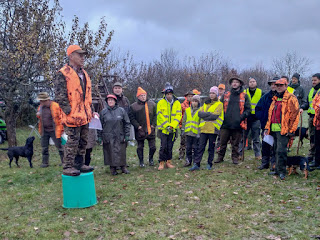
Jagdleiter Rudi is welcoming and giving instructions to the
hunters and Treiber. It is his Revier, and this Treibjagd should help him
meet his quota of Reh and Wildschweine for the year.
"Quota" isn't really the right word, but hunters who own or lease Reviere here are responsible for shooting a certain number of roe deer and wild boars each year to keep the numbers managable and to fend off the ever-threatening Afrikanische Schweinepest (pig plague). If he does not fulfill the written goal, there may be serious consequences including - if he misses the goal several years in a row - losing his hunting ground. I just wanted to point out that this type of hunt isn't just for fun. The herds need to be culled because we humans keep reproducing and needing more and more fields for growing crops, and herds of deer and wild sows with their Frischlinge do horrible damage to crop fields, which the hunters have to pay for because it's their job to keep the wild animals out of the crop fields! We also killed all their predators (wolves), so nature can't regulate things on her own. I've learned about all of this during the Jagdkurs.

The job of the Treiber is to tromp through the forest making enough noise to convince the wild game to abandon their cozy shelter from the rain and dash away from the stupid noisy human. The Schützen need to be on alert with all their senses, being ready to shoot a sow or deer passing by but watching out for - and not shooting - the hunting dogs and the Treiber. They listen for the Treiber shouting out their location, the animals running or strolling through the forest, the dogs barking to indicate they've flushed something out... And their noses can tell them if a rauschiger Keiler (boar lookin' for love) is anywhere near.

Teckel/Dackel/Dachshund
staying warm before the hunt
The dogs' job is to wait patiently and quietly until they are let off the leash (punctually at Jagdbeginn, 10:00), and then run willy-nilly through the forest, barking and unsettling the game so they move to where the Schützen can get them. Their barks have a different tone, usually more frantic, when they're on the trail of a fleeing deer or Wildsau. The dogs I saw here today were several Teckel (Dachshunds), a Deutsch Drahthaar, a Brandlbracke, at least three Slovensky Kopovs*, and a black lab or two.

*I had to ask the handler for this breed because I didn't recognize it and it's not on my list to study for the Jägerprüfung. They had the look and coloring of Brandlbracken (black-and-tan hounds) but were too small and yet clearly not puppies.

Shortly before 10:00 our group set off from the shelter of Rudi's Jagdhütte and headed toward the forest. The terrain here was much more challenging than that of our first Treibjagd, being very hilly and full of blackberry patches. Treiben is a great (volunteer) job for people who like being out in nature. You're not restricted to paths - in fact you're really supposed to avoid the paths and stick to the rough, and you might get to see some wild animals. I only saw three dashing Reh, but M also saw a few foxes as well as a Wildschwein (wild boar).

We fought our way through thick forest undergrowth, up steep hillsides, down into valleys, and over ditches. The blackberry branches bit through our pants but couldn't tear them, the tree branches did their best to poke out our eyes, and everything on the forest floor gave its best effort to trip us and throw us on our asses. But in the end we prevailed - we made it out unbroken and unshot, as did everyone else.


After the hunt the organizers provided us all with delicious and warm Gulaschsuppe, good German bread, tea, coffee, or Glühwein, beer and water. There were two firepits burning to help us thaw the cold bits, and three Metzger (butchers) were on hand to do the Aufbrechen (gutting). One of the Metzger had a crowd around him and didn't just gut the boar - he talked about what he was doing, teaching how it's done and what to look out for (abnormalities in the organs). Several of us were clearly students who will have to identify internal organs for our test, and he showed us each of the important steps and parts.

I'll spare you those photos, but I have them and was not the only one taking pictures. All in the name of learning!

The traditional Strecke legen followed, where the animals are laid on pine branches to be counted and also honored along with the hunters who shot them. Rudi's wife thanked everyone for the good and safe hunt and called up each hunter who'd shot an animal (or three in one case!). Following custom she took a pine branch, stroked it against the animal the hunter had killed, and handed it to her or him to put in the band of his (or her - there were at least two women who were successful hunters today) hat with a "Waidmannsheil!"

12 Sauen, 22 Rehe, 9 Fuchse
After that the Jagdhornbläser performed several traditional tunes including Sau tot, Reh tot, and Fuchs tot."


This brought the hunt to its official end. The Metzger still had a lot of work to do, but the Treiber und hunter-shooters could slowly make their way to the pub/restaurant where Rudi said they are welcome to celebrate "bis zum Erbrechen."

One of my many questions was answered when I heard one hunter say he was going to drive his "Kanone" (gun) home and then come back to the pub. I've always wondered what a hunter does between a Treibjagd and the Schüsseltrieb afterwards - the social celebration. In Germany if one is caught in possession of a gun AND has more than 0.0% blood-alcohol level, he faces stiff penalties including likely the loss of his hunting license and gun license. I know what the hunter is supposed to do - not drink any alcohol as long as he still has his gun with him, or drive her gun home, lock it in her Waffenschrank (gun cabinet), and return to the party. A relative can't just come, pick up the gun and take it home because one is not allowed to transport a gun without a gun license.
Anyway, I was glad to hear this hunter's answer to the situation, which reflects the law.

This was our last planned Treibjagd for the season, and after I hit "publish" on this post I'm going to drag my tired Kadaver to the sofa for an evening nap. But we will very likely do this again next year. After all, we now have the proper outdoor clothing, so it would be a shame to just let it hang in a closet.


To all of today's successful hunters: Waidmannsheil!!