Showing posts with label education. Show all posts

Saturday, March 5, 2022

Reading Banned Books

In the midst of the horror of Putin’s attack on and invasion of Ukraine, it seems petty to write about anything else. Another part of me says those of us who are able also need to keep living and functioning while we still can. The outpouring of aid in the way of helpers, goods, and money going to those having to flee their homes because of that man’s madness is at least something to give us hope. Reading and writing is a way for me to keep a grip on what still works in this world.

Before Putin’s war started I was planning my reading strategy for the next few months: focusing on books banned at some time and place in the US during the last several decades. That began after I found out that Art Spiegelman's Maus had been removed from the 8th grade curriculum in a Tennessee district due to nudity (it’s a graphic novel about the Holocaust featuring mice as the main characters) and a few “naughty words.”
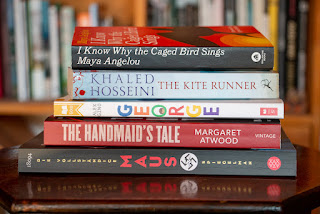
Not pictured: Looking for Alaska
I gave it to a friend to read.

Notice: This post contains no spoilers. 

I ordered the book again (having left my first copy in my German classroom when I left the US), though I accidentally ordered the German version. Therefore I can’t speak to the “naughty words” other than assuming “verdammt” (damn) was a problem. And indeed, there is a drawing of a human in a bathtub – the author’s mother in a flashback scene – and two curved lines and dots amount to human breasts. In a drawing. These book-banners are unbelievable. Spiegelman’s graphic novel is a brilliant way to introduce young readers to the horror of the Holocaust. The fact that the Jews are mice and the Nazis cats softens the shock a bit for younger readers. But because of two breasts and a few swear words, this group of parents and/or school board members thinks the book should be removed.

From there I moved to the Handmaid’s Tale, which I found less shocking than I expected to. That one has been banned/challenged for profanity and “sexual overtones.” Those who aim to ban books haven’t been listening to their children or their children’s friends, have they? It's more than a little ironic that the book-banners don't object to the fact that an entire class of women are nothing more than breeding machines with no rights, but a few swear words put them on alert.

Looking for Alaska was the next one, having earned a spot on the Office of Intellectual Freedom's Top Ten Most Challenged Books list several years running. Challenged because of a sexually explicit scene that could lead readers to experiment and for profanity. I’m sorry to say I don’t even remember the sexually explicit scene. Very briefly put, it tells the story of several teenagers at a boarding school and the struggles of growing up. 

George, by Alex Gino, was my next banned book, having appeared as #1 on the above Top Ten list for the last 3 years in a row. This is a YA (young adult) novel about a child in grade school who was born a boy but is sure she is really a girl. It’s a story told from the point-of-view of a trans girl, and that apparently scares book-banners. One of the stated reasons for the challenge is that the book contains a transgender character. I think they fear that reading such a book might make a reader say, “Yes, that is the life I want for myself.” I'm no expert, but I'm pretty sure that’s not the way it works.

My most recent book was The Kite Runner. I’d heard of it before but didn’t know anything about it. This multigenerational novel tells the story of two boys from Afghanistan: Amir and his family’s servant’s son Hassan. I got choked up on the last page, and that does not happen to me often. The objections to the book that I find most ridiculous are that it could promote Islam (several of the characters pray, some regularly) and that it contains homosexuality. It does NOT contain homosexuality, for heaven’s sake. There is a rape scene and both perpetrator and victim are boys. But that is not homosexuality. Do we describe a rape scene where the perpetrator and victim are different genders as “heterosexuality”? Honestly…

I’m now reading I Know Why the Caged Bird Sings, by Maya Angelou, and feeling somewhat scornful of myself for not having read this earlier in my life.

The other books I have read so far this year, with the exception of Getting Along with the Germans, would very likely also be banned or challenged somewhere in the US because of “profanity.” It seems that the appearance of even one “goddamn,” “fucking,” or “holy shit” can get a book challenged by people who clearly don’t spend much time around the young readers they are pretending to protect from the realities of the world. 

I watched the part of a school board meeting in McKinney County, Texas in which students, parents, and teachers were invited to speak about a list of 282 books a set of parents wanted removed from the library shelves, and my jaw dropped several times. Already during the second speaker a man had to be thrown out for trying to shout her down for opposing the ban. Happily there were others who also spoke against the challenge. Here is an open letter from the author of one of those books, which I have on order. The letter fell on deaf ears because it was published before that school board meeting. What else would you expect?

One parent said he objects to his tax money paying for books he finds offensive to be on the shelves. I could almost understand that, until he said parents who don't object to those books should just go out and buy them. Some children can only read what the library provides because their parents cannot afford to order from Ama*on every time their child wants to read a book. How much of that first dad's tax contribution goes toward a $14 book? Or even 282 $14 books? He needs to sit down.


As one person on Twitter wrote, “Parents, your kids have access to the entire internet on their phones almost all day long. Books are not the problem.”

"STOP BANNING BOOKS!!!"


On the other hand, the best way to get kids to be interested in something is to tell them they shouldn’t be. The best way to get kids to read a book is to tell them it’s off limits.

But seriously. Stop banning books. Go to your child's library, give the librarian a list of the books your sheltered child is not permitted to read, and leave the rest of the world alone. Better yet, when your child wants to read a book, you read it also and talk about it together. Oh damn. I forgot. One of the challenges to the book George (see above) was that "schools and libraries should not 'put books in a child's hand that require discussion'." Good grief.

By the way, book banning is not a thing in Germany nowadays. It was once, but they've wisened up since then. 


Friday, April 19, 2019

Hunting in Germany: Part 1

Der Weg zum Jagdschein

For more than a year now I have been seriously interested in pursuing falconry and becoming a Falknerin. In order to meet this goal in Germany I need to first earn my hunter's license. I went back and forth for months wondering whether I really had a chance at accomplishing this, and by now I have taken the leap and begun my pursuit.


These two brochures from the Landesjagdverband e.V. and
Deutscher Jagdverband e.V. contain lots of helpful information
about hunting in Germany, some of which I include below.
As is my style, I wanted to find out everything I could before signing up for a class. I want to go into this with my eyes wide open. I didn't necessarily anticipate that my eyes would pop open with shock and awe, but oh well. At least I know what I'm getting into.

To help me mentally prepare for what is upon my doorstep (my hunting class begins in June), I wanted to write this post - perhaps also for posterity. I suspect anyone from the homeland who knows about hunting and hunting license requirements there will be rather surprised at the way things are done in Germany.


Prerequisites for Hunting in Germany

  • Completion of a certified Jagdkurs [hunting course] (min. 130 hours)
  • Successful completion of the 3-part Jägerprüfung [hunting test]  (written, oral, shooting)
  • Possession/purchase of Jagdhaftpflichtversicherung [hunting liability insurance]
  • Minimum age of 16 (limited/probationary license)
    Minimum age of 18 (regular license)
  • No criminal record
  • Mental and physical fitness and aptitude
  • Cost: €1500 - €2000 (hunting course + test)


Jagdschulen / Hunting Schools

There are many private hunting schools in Baden-Württemberg. I needed to shop around to find the type of class that fit best to my learning style and schedule, and with the help of a family friend - the former Landesjägermeister of Baden-Württemberg - I've settled on the Landesjagdschule Dornsberg, (LJS) not far from the Bodensee.

Types of Courses

Except for evening classes, the courses are generally made up of 18 or so eight-hour days. Those days include classroom work, practical and hands-on instruction (identifying flora & fauna, gun handling & safety, and field dressing [gutting] prey, for instance) and shooting. The LJS allows students to combine sessions from the various types of courses when flexibility is required.

Compact Course, Summer

The "summer holidays" in Germany are only six weeks long, so this class is quick and intense. The one at the LJS runs for three weeks including one two-day break and an intensive three-day review session before the test.

Weekend Course

This course is run one weekend a month, Friday through Sunday, followed by a final eight-day block, and stretches over five to six months.

Compact Course in 3 Blocks

This course extends from June through August, one week per month. This is the one I've chosen because I know I need time in between blocks to review and prepare for the next one. This also includes the intensive three-day review session before the test. The test is scheduled for the time we'll be in Scotland, so I will be taking it in November. We'll find out if that's an advantage (more time to study) or a disadvantage (more time to forget stuff).


Theory Topics

There are five different areas of study for the theoretical portion of the class, which takes about 100 hours of instruction. This is where I will be wishing I had paid better attention in the few science classes I couldn't avoid taking while still in high school. Seriously, I believe I took one year of basic biology. In college I took geology because it was the lowest/easiest science class one could take to meet the graduation requirement. My 50-year-old self would like to travel back in time and whack my 16-year-old self with a 2-by-4.

  • Wildtierökologie & Revierbetreuung [Zoology; Animal Biology & Care of Hunting Ground]
  • Waffentechnik, Waffenrecht, und Führen von Jagdwaffen [Weapons Technology, Gun Laws, and Weapons Use and Safety]
  • Jagdausübung, Jagdarten, Jagdeinrichtung, tierschutz- und artgerechte Haltung &  Haltung, Führen und Einsatz von Jagdhunden [Hunting Practices, Types of Hunting, Hunting Devices, Species-appropriate Care and Training of Hunting Dogs in accordance with Animal Welfare]
  • Jagdrecht, Tierschutzrecht, Naturschutzrecht und Landschaftspflegerecht, Jagdethik [Laws pertaining to Hunting, Animal Protection, Environmental Protection andLandscape Maintenance, Hunting Ethics]
  • Wildkrankheiten und Behandlung von erlegtem Wild [Wild Game Illnesses and Handling of slain Game]
In addition I will be learning about and tested on:
  • Wildhege [Gamekeeping]
  • Biotoppflege [Care & Maintenance of Habitats]
  • Land- und Waldbau [Agriculture & Forestry]
  • Wildschadenverhütung in Feld und Wald [Prevention of damage caused by wild game in field and forest]
At the Jagdhundetag
LJS Dornsberg, April 2019

Why do I have to learn about the care and training of dogs? Because in Germany "Jagd ohne Hund ist Schund" ["Hunting without a dog is rubbish"]. I have read again and again that there is no type of hunting for which a suitable and well-trained dog is not necessary. In other words, one should never hunt without a dog. The dog can assist the hunter in flushing out game, but perhaps the more important part is finding and retrieving or leading the hunter to the dead or wounded animal.

For the shooting part of my education, I will need to learn how to handle and shoot with the Langwaffen [rifle and shotgun] and Kurzwaffe [pistol and revolver]. At this point I can't even tell a rifle apart from a shotgun, so the gun business might be my biggest challenge.

THE TEST

The state hunting test stretches over two or three days. The entire test is conducted in German; there are no accommodations for non-native speakers like me.

1. Written Test

This is a multiple-choice test with 25 questions on each of the five topics I listed above. In B-W, there are anywhere from three to six possible answers to choose from, and any number from 1 to 5 could be correct. You are not told how many answers are correct, but grammar can help here with the phrasing of the question. (“Which of the following animals IS…” vs. “Which of the following animals ARE…”) I have 150 minutes to answer the 125 questions.

Thank goodness the entire pool of 1250 questions
is available on the internet.

2. Weapons Handling and Shooting Test

For this part I need to demonstrate skill and accuracy at shooting with rifle and shotgun as well as handling the weapons safely. If I fail at this, I fail the test; I cannot compensate for lack of competence with guns with really good performance on the written portion of the test.

Büchse [Rifle]: 
I need to be able to shoot a stationary deer target from 100 meters (328 ft) and a moving wild boar target from 50-60 meters (164-197 ft).  None of the targets are real/live!

Flinte [Shotgun]:
I must shoot running rabbit targets from 35 meters (115 ft).

Kurzwaffe [pistol and revolver]:
This is for short-range, as in ending a wounded animal. It sounds like I won't be tested on this in B-W, but other states might require it.

Büchse? Flinte?
Clay pigeons were the target.
Tennessee USA, 2014


3. Oral and Practical Test

I will be tested on all five topics here as well, this time in front of a panel of judges. This could involve a walk through the hunting ground with a hunting simulation in which I have to tell how it should be properly handled. I will be required to identify hunting dog breeds, game animals, internal organs of game, plants, and trees from photos, models, or in the field. I am as yet unsure if I will need to actually "field dress" an animal during this portion of the test.


Can you identify this breed?

What about these two?

If I pass that test, I will then be able to apply for my Jagdschein [hunting license] and then a Waffenbesitzkarte [license to own a gun]. If I do not feel confident with the guns and shooting, I can skip that part of the test, and passing the other two sections, I could then get an eingeschränkter Jagdschein [limited hunting license]. That would be enough for me to then pursue my Falknerschein [falconer's license].


Hunting in Wisconsin

If I had written this blog post about what I personally would need to do to obtain a hunting license and go hunting in Wisconsin (USA) if I were still a resident, it would have been much shorter:
  1. Obtain (buy) a gun.*
  2. Register the gun with the proper authorities.
  3. Pay $165 for a Conservation Patron hunting license (allowing me to hunt all types of large and small game available in Wisconsin).
  4. Find somewhere to hunt.
*This used to involve a 48-hour waiting period, but ex-governor Scott Walker repealed that in 2015. There is now no waiting period in Wisconsin, though the required background check does take 3 to 5 minutes.

Since I was born before January 1, 1973, I would not need to take any kind of class: Not a hunter's safety course, and not a course on how to handle a gun. I could buy any type of legal gun at a sporting goods store.

If I decided a class would actually be a good idea so I have some clue how to aim and shoot, which animals I am allowed to shoot, etc., I could find a Hunter Education Course in most communities or take an online class. The one I linked to costs $24.50. A hunter over the age of 18 pays an additional $10, though I don't know why. I found an in-person weekend class in southern Wisconsin which runs Saturday and Sunday for eight hours each and costs $10 total for the two days. Many such classes are taught by volunteers - experienced hunters who are enthusiastic about teaching.

The German Jägerprüfung, or hunting test, is often called "das grüne Abitur." (The regular Abitur is the graduation test students in Germany must pass at the end of high school in order to qualify to study at a university.) This is serious business, and it requires weeks and months, if not years, of study and preparation. I hope I am up to the challenge.


All things to do with hunting in Germany begin and end with horn blowing.
LJS Dornsberg, Jagdhundetag, April 2019


Wednesday, January 13, 2016

Back to Class

I haven't written much lately because I have been otherwise engaged and because I've got some things on my mind I want to write about but that seem too heavy and serious for this blog. I have nearly completed several posts that I probably won't publish, and no fun or funny ideas have come to mind since the new year.

On January 7th I started teaching German again! I have made reference several times since November about getting involved with efforts to help refugees in our area acclimate to life here, observing occasionally and participating in one class or another at the Herman-Hesse-Kolleg among other things. When one of the teachers became no longer available, the director asked if I'd want to take over his afternoon class. Only one student showed up last week (a possible miscommunication about when classes resumed after Silvester) but this week more students came to make up a full - but small - class.
Update: This afternoon everyone on my class list was there; I have 16 students.

I had a fabulous Day 1 with my new class  on Monday! These refugees adult students from Syria and Eritrea want to learn German, learn quickly, are motivated, ask great questions, and were willing to participate in all the activities I'd planned. They have a wonderful sense of humor, are very respectful, help each other and want to know what I can teach. Despite the fact that three years ago I said I would be happy to never set foot in a classroom again, this is different. I have always wanted to teach an entire class of students who want to learn.

Several times on Monday I stood there while the students spoke Arabic to each other clarifying something for those who didn't understand my explanation, after which I said confidently, "Yep, exactly!" They knew I didn't understand a word, so they laughed. I realized as I was listening to them that Arabic sounds really beautiful, and I certainly wish I could understand it.

Look, I know it was just Day 1. I've had many Day 1s before. Surviving them is key.  This is more than surviving, though. I enjoy planning lessons and activities, I look forward to going to class. and I feel in my element in the classroom, especially with these students.

This is our classroom.
I hope the students do or will feel like they're making progress with me, and that they look forward to coming to class as well.

I studied English and German in college. I taught English for 16 years and German for 13 years to teenagers in Wisconsin. I've had exchange students in my classes from various places around the world. And I am certain that everything I have done in my educational and professional life has been preparing me for this. These students need to learn German to function here in Germany, and I have the time and ability to help them do so. I've already told them my German is not fehlerfrei (free from errors), but because I have also gone through the process of learning German, I understand some of the challenges they're facing.

What an experience this is!

One last thing. You've heard about the terrorist attacks including the one in Istanbul yesterday in which a group of German tourists were killed. You've heard about the assaults and thefts in Köln (Cologne) on New Year's Eve. You've probably also heard about right-wing neo-nazi types protesting about having so many refugees in Germany and burning down facilities that either are being used or are intended to be used for temporarily housing refugees. What you undoubtedly haven't heard of - unless you live here in Germany - are the many, many Germans who are reaching out, getting involved, and volunteering in their communities to help refugees. Groups are popping up all over and organizing getting-to-know-you coffees or meals, arranging talks with speakers who help the Germans and the refugees understand each other better, and finding ways to help the refugees integrate. Retired teachers are coming back into the classroom to teach basic German, churches and community centers are offering available space for German classes, tutoring, and for doing homework in a quiet place. I could go on and on.

The refugees with whom I have spoken have said their impressions of the Germans they have met face-to-face are very positive. Locals have helped them learn about the way of life here, the grocery store routine, visiting a doctor, introducing them to local dishes, showing them around, inviting them to join a Fußball (soccer) team, tutoring them in German, and answering the many questions they have, like "Why are there suddenly red and white flag banners hanging around the streets of Horb?"

Oh lordy...Fasnet/Fasching is coming.

It is wonderful to see what people can do when they are not blinded by fear and prejudice. I just want my faraway readers to know that there is a lot of good going on here in Germany, despite the fact that the press usually prefers to report on the bad.


Saturday, May 30, 2015

Oh, Wisconsin

Teachers in Wisconsin recently got another kick in the face with the state government's earnest attempts to strive to reach the bottom of the pile in terms of standards for teaching, education, and learning.

Wisconsin State Capitol
It's always so sweet when politicians on committees* make decisions about education based only on the all-important bottom line ($$$) with no regard for what works in real classrooms. With the interests of the state at heart, they have to find places to cut spending to make the budget look good, and the first place the Republican representatives like Mary Czaja gleefully hack to bits is education. At the local level when faced with less money to educate kids, programs like foreign language, art, and music get slashed (never anything sports-related, of course, because after money, Americans value sports most of all). Languages, music, art...that's just culture, and who needs that?

*COMMITTEES:  Because none of us is as dumb as all of us

(thank you, demotivational posters of despair.com)

The most alarming part of the state's proposed budget (but believe me, there are other significantly alarming bits regarding education) is that a teaching license will be as easy to get as a fishing license** for people who want to teach 6th to 12th graders. As long as a person is deemed by the public school district or private school "proficient" in the area s/he wants to teach and has real world experience in the subject field, s/he will be granted a license to teach by the state.

**For the benefit of my German readers, a fishing license in Wisconsin does not require knowledge of various types of fish, techniques used for fishing, or rules as it does here - you just go to a gas station that sells fishing licenses, pay the yearly $15 fee, and collect your permit.

Even a bachelor's degree won't be required to obtain a teaching license except, perhaps, for the four core subject areas: English, math, science, and social studies.

This means that (for example) if your neighbor graduated from high school, married a German [real world experience], can convince several people who don't speak German that he can, and perhaps spent some vacation time in Germany [more experience], he will be granted a license to teach German to middle and high school students in Wisconsin (grades 6 to 12).

However, since German programs are being cut left and right in Wisconsin schools because there's just not enough money and the whole world should speak English anyway, that wasn't the best example.

Your other neighbor who owned a small cafe can teach business, computer, and economics classes because he has real world experience in the field of business. Mary Czaja herself suggested that, for instance, a local mechanic could teach middle and high school shop classes. I have a lot of respect for mechanics, but I would be slower to suggest they should teach a bunch of 6th to 12th graders in a classroom.

To teach math or science the candidate might need a bachelor's degree, but still no classes in how to teach. Any idiot can teach a class of 25 hormone-infested teenagers most of whom don't give a flying shit about the class, after all. Right?

It doesn't take any special skills or talents to teach while dealing with all the interruptions that come in the course of a class period as well as the students who approach the teacher after the starting bell to announce that they have returned from their week-long hunt with Dad but didn't do any of the homework she prepared for them before their departure as requested because they were, well, in a tree stand all week, and are wondering if they missed anything during their five-day absence. The emails from parents wondering why their child is not getting an A in the class when she got As in all her previous math classes will also be no problem - the untrained teacher can answer those during her 45-minute prep period. Learning the various components of an effective lesson or unit plan? Pish posh. This teacher won't expect to have to deal with a 10th grader wimpering, "Mrs. Smith, Johnny took my pencilllllll!", but that won't be a problem either because she has real world experience and is good at math.

No longer will the people standing in front of your child's classroom have to waste years and lots of money on college classes focusing on teaching methods, assessment strategies, reaching students with special needs, multicultural education, philosophies of education, or any of the other silly classes that prepare a person for the teaching profession. If they can present themselves in an interview as competent enough in the subject area and possessing real life experience, they're good to go.

With that line of thinking, since I raised two children to adulthood, I should be able to get a Wisconsin medical license to be a pediatrician, a counselor or therapist, a nutritionist, or a nurse. Someone who has tinkered with wiring in his own and friends' houses without electrocuting himself or burning anything down should be able to get an electrician's license in Wisconsin.

Home schooling isn't even legal in Germany - for religious or any other reasons - because in Germany formal education is deemed important enough to be handled and directed by professionals. In Wisconsin, though, if this budget passes, just about anyone will be able to get a license to teach classes of other people's children from 6th to 12th grade whether he or she is cut out for teaching or not.

Good work, Wisconsin. Good work.

the Wisconsin high school where I taught for 13 years after wasting time in college
and taking additional classes after college to learn how to be an effective teacher