Showing posts with label Tübingen. Show all posts

Sunday, October 14, 2018

Worldwide Photo Walk

photo credit: M
Earlier this month M and I did something very unusual for us – something social involving strangers! You have no idea how far out of our comfort zone this was. To add to the nerve-racking adventure, we took the train! That’s nothing to me, but taking public transportation raises M’s danders and defenses. It was a quiet ride until we reached Rottenburg and a gang of middle-aged Volksfest-goers got on. They were loud, shrill, wearing Dirndl and Lederhosen, and clearly heading for a good time. 


Tübingen
The event we were going to join was Scott Kelby’s Worldwide Photo Walk. This has been going on for 11 years, but I only recently heard about it. In mid-August Kelby announces the walk and opens his site for registrations, and the walk takes place on the first Saturday of October. Volunteers who are interested and willing apply to lead a walk – in any city in the world! – and then people can sign up to join them. For a while the closest one to us was in Ulm, but more recently a walk in Tübingen popped up. That’s a mere 40-minute train ride from our village, so we signed up!


What’s the point? You can go to this FAQ page for lots of information I don't need to repeat here. Basically it’s an opportunity for folks interested in photography to meet each other, get together, talk photography, and take pictures while ambling through a town or city. The advanced version is to try to take pictures that tell a story of some kind. This is going on in cities all around the world on the same day. Something worldwide and peaceful - imagine being a part of something like that! 

At the end of the walk the group may decide to go together for a meal or drinks, and a few days later there is an optional contest for walkers to submit their best photo. The photo must be one taken during the walk, though - submitting one from a different day or even time of day that you like better is cheating! All the photos in this blog post were taken during our walk, even though I have hundreds of other pictures from Tübingen, many of which are better than what I took that day.


Worldwide Photo Walkers in action
This year there were 932 walks and 17,464 walkers registered around the world!

We were a group of six: 2 Germans, 3 Americans, and a Brit! We all had DSLR or mirrorless cameras (though there’s nothing that says you can’t do a photo walk with just your smartphone). We were a rather eclectic group, and we got on well together. I guess you never know with a group – there’s usually “that one guy” who is annoying, or “that one woman” who won’t stop talking… But this was not the case for us! At the Brauerei at the end we exchanged contact information and agreed to stay in contact.


We all took general photos of the corners of Tübingen our leader, Frank, took us to and through, but also went for artistic shots of bicycles, benches, baskets, and Blumen (flowers). And although I thought I had already seen most of the pretty spots in Tübingen, Frank, who has lived there since his college days, showed us places unfamiliar to me!


One of our group, Jim, writes a photography blog in which you can see his creative photos, how he sets them up, and the settings he uses. His portfolio is impressive as well - and less reading for those who just want to see great photos! Frank does photography at mainly concerts on the side of his "day job," and he had some tales to tell about that scene! James also has a website of his photography and the services he offers. James took a class from the great Ansel Adams years ago and shared some of what he learned from him with us as well as some stories. When he first shared that, this was me: "Wait...You met ANSEL ADAMS?!?" What a dork (me, not Ansel).


Looking at truly exceptional photos taken by real people I've actually met has rather inspired me to finally really learn how to use my camera rather than stumbling around and hoping for the best, and to get around to becoming comfortable with Light Room / Photoshop. I am going to do this! It's long past time for me to stop handing my memory card to M and asking him to tweak a photo for me...

Although we were only 6 walkers*, we got quite some looks from people sitting in the Straßencafés as we passed by with our big cameras, long lenses, and tripods. Since most common folk are content with their smartphone photos, they tend to think people with cameras like ours are journalists. I've been asked more than once which newspaper I'm with, and it always makes me grin. If they only knew how clueless I am...
*My son tells me the zombies in "The Walking Dead" are also called "Walkers"!


a deep discussion about...something I didn't understand
Before we left for Tübingen I wrote to my dad in Wisconsin and told him what we were up to. When he woke up he got online and found a walk registered about an hour from him. From his description the experience wasn't quite like ours. but he's glad he did it.
photo credit: mein Vater
Cedarburg, WI USA
We're already talking about next year. Esslingen just screams, "DO A PHOTO WALK HERE!!!", and I proposed to my dad that it might be kind of fun to add a sister-city twist to the photo walk. So M and I organize a walk in Esslingen, my parents do one in Sheboygan, and we share that as a sister city activity. Schau'n mer mal. We'll see.

After I earn my Falknerschein, then wouldn't it be cool to organize a "Worldwide Photo Walk with a Hawk"?!? Yeah, I'm full of ideas.

In case you read this far, here are my tips for participating in Scott Kelby's Worldwide Photo Walk:

  1. DO IT!!
  2. Find a walk somewhere near you, and if there isn't one check back often - walks are added every day.
  3. Register on Kelby's site so the leader of your walk knows you're coming.
  4. Join the WWPW Facebook group. It is so cool to see how many different cities around the world are represented and the often brilliant photos people post afterwards!
  5. If you realize you can't make it, go back online and unregister so the group doesn't wait for you. Though if you register for my or my dad's walk, don't worry about it - we won't wait for you anyway if you're late.
  6. Watch what the other photo walkers are taking pictures of, especially the walkers you sense are skilled photographers. Good photographers have an artistic eye that the rest of us often lack. This is a link to James' photos from our Tübingen walk. How many people would think to photograph that bench? I certainly walked right past it without even seeing it. Both James and M saw it, though! A bicycle among flowers caught both Mark's and M's eye, while I stood there saying, "Gee, too bad for the bike - I'd otherwise photograph the flowers." Learn from the others!
  7. If your leader has organized a meal or coffee afterwards, join in! 
  8. Share your photos with whatever social media platform your group organizes. Our group used Instagram, and though I don't have an account, I can still view the others' photos, and I sent a few of mine via old-fashioned email.

That's it! 

What do you think? Would you do a Photo Walk? What about next year?
Next worldwide walk: Saturday, October 5, 2019


photo credit: M


Wednesday, December 3, 2014

Tübingen's Chocolate Festival

I never need an excuse to go to Tübingen. It's a beautiful university town only 35 minutes from us by train, and I've been there often enough that I know my way around quite confidently. I even gave a short city tour to the mayor of Sheboygan, Wisconsin and his entourage last spring. It's definitely one of the top towns to visit in Baden-Württemberg.

This week Tübingen is holding its annual Chocolate Festival, which I had never been to before, and since my daughter is visiting and loves chocolate and buying chocolate for her friends, we put it on our itinerary. What better reason to hold a festival than to celebrate chocolate?!

We intended to go yesterday, but we woke up to blowing snow and the weather report didn't look promising for the rest of the day. Today's damn lie of a weather forecast claimed dry and gray, so we postponed our trip. The forecast nailed the "gray" part (we haven't actually seen the sun since we returned from the U.S. on Friday morning), but we were soaked by the time we stopped for our first Glühwein with a really pleasant combination of rain, snow, and puddles.

Chocolate-covered apples, anyone?
At the Chocolate Festival you can find hot chocolate, chocolate-covered fruits of all normal and exotic kinds, bars of chocolate, discs of chocolate, jars of chocolate, chocolate beer, candies, white chocolate, cinnamon chocolate, jalepeno pepper chocolate (basically any flavor you can think of and a few you wouldn't combined with chocolate), chocolate art, "African Bushman chocolate" as well as chocolate from many other parts of the world, chocolate beans, blocks of chocolate topped with nuts or dried fruit, and .... you get the idea.


Chocolate art - a corset painted with chocolate


Chocolate beer

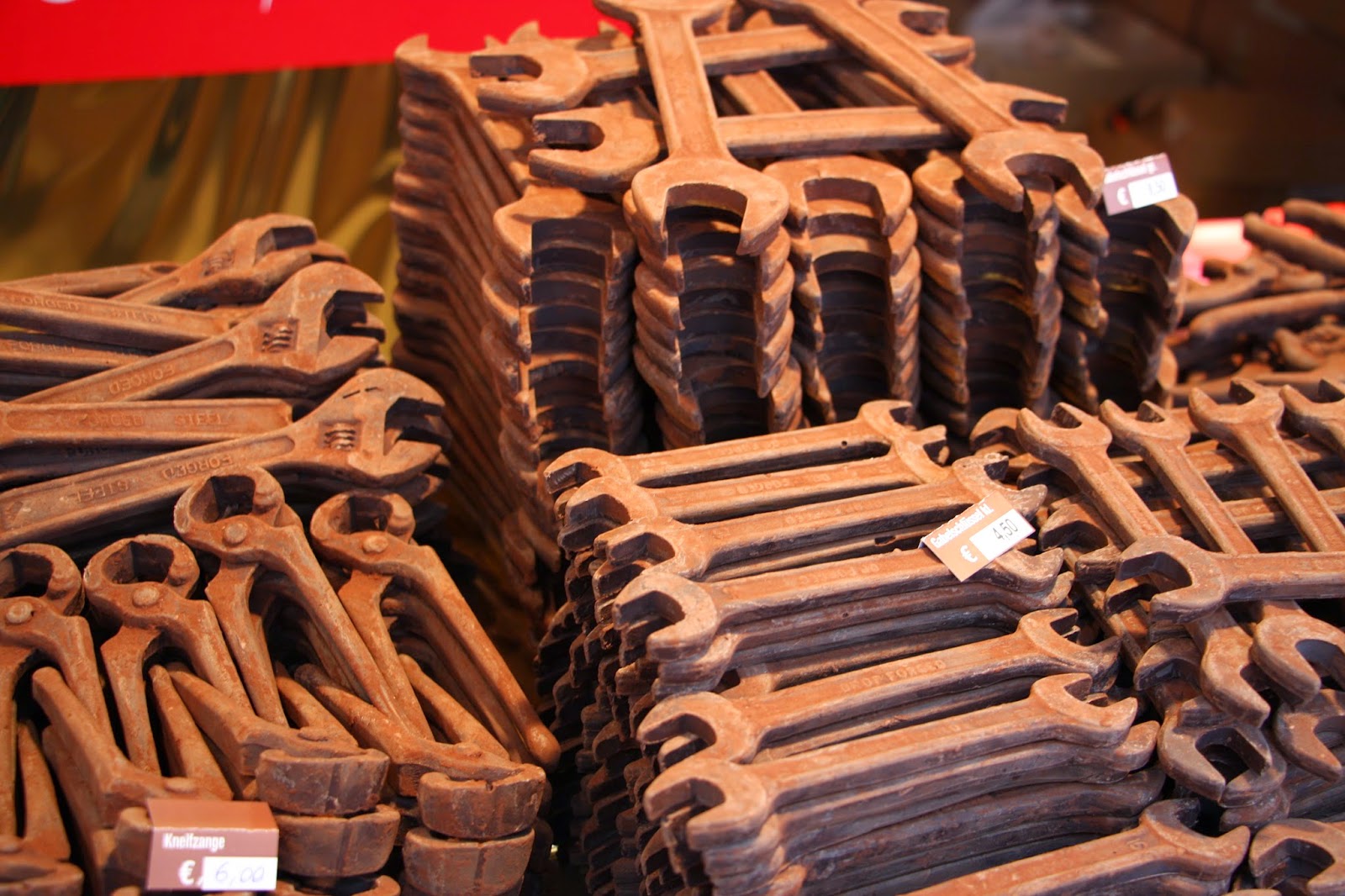
One of my favorite stands is one with Belgian chocolate which is made to look like old rusty tools. I gave some of these to my son for Christmas last year, and he said they were delicious.

If you eat this much chocolate, you're screwed!

hammers, railroad spikes, pliers, and horseshoes

Gabelschlüssel - open-jaw wrenches
I was considering some candies with dried fruit, but the guy working the stand freaked the hell out of me by speaking enthusiastically in Italian while looking at me and alternately shouting Italian to the person working the booth across from him. I opened my mouth to ask a question, switched to a addled smile, and sidled away. Italians are scary. And that's bad, because we're going to Rome next week.

As we decided to check out our favorite Flammkuchen restaurant for lunch (Ranitsky Kaffeehaus), my daughter heard someone call her name. I turned around to see one of my former students from our tiny little school in tiny little Fond du Lac, Wisconsin and her friend who was an exchange student at the school about five years ago! We chatted for a bit, and then of course kept bumping into them for the next hour or so. 

Since Ranitzky's was jammed full without half a table to spare, we decided to grab a Bratwurst at a stand, which is really the thing to do at a festival or Weihnachtsmarkt anyway. For my three Wisconsin readers, a Bratwurst here is nothing like a Bratwurst in Sheboygan. You'll just have to trust me on that, because I didn't take a photo.


Of course the regular market is going on as well, and you can therefore find fruits, vegetables, and flowers without a chocolate coating.

By early afternoon the college students were awake finished with classes, families had picked up their children from day care, and tourists had found Tübingen, so it was starting to get crowded. This is when my daughter and I start wanting to punch people, so we chose to head for the train station via two bookshops.


Between bookshops we passed a stand with a basket of chocolate-covered obviously freshly-made potato chips on display. I wheeled around and returned, and had a conversation with the vendor nearly worthy of a Douglas Adams novel (translated below into English):

  me: "I'd like one portion of chips, please."
  guy: "Large or small?"
  me: "Small."
  guy: "With chocolatesaltbalsamico?!"
  me: "Er...yes, please."
  guy: "With chocolate?"
  me: "Yes."
  
Guy takes a fresh potato, puts it into a fancy little machine that twirls it and shaves it into chip-shaped ribbons, then drops them into a fry vat.


  guy: [to helper] "Without salt."
  me:  [to myself] "What fool would order potato chips without salt?" 
  guy: [handing me my small bag of chips] "3 Euros, please."
  me: "With chocolate, please."
  guy: "Yours doesn't have salt. With chocolate it costs 4 Euro."
  me: "It doesn't have anything on it?"
  guy: "Balsamico?"
  me:  "Do they already have balsamico on them?" (that would have been fine, too)
  guy: "There's nothing on them."
  me: "I'd like chocolate."
  guy: "Ok, one more Euro, please."

I paid him another Euro and he dribbled some chocolate on my chips.

Although he was not a native speaker either, we were speaking to each other in German. It was one of those "What on earth is wrong with my German?!" experiences.

Anyway, the chips were delicious despite the lack of salt, and I should feel lucky I came away with more than an empty bag.


We took an earlier train home than we'd planned to take, but we'd seen and done what we had wanted to and decided a brief nap would be ok, too, though I wrote this post instead. 

I think a future thread for my posts might be "Spotted in a Crowd". If so, some of today's entries would be:
  a couple having a heated marital spat in sign language (we saw them twice - it was quite an argument!)
  a beautiful Bernese Mountain Dog focused intently on his human's lunch
  an adorable class of Kindergarten children sampling offerings at every booth
  a woman walking around with an open umbrella long after the rain had stopped
  and of course: former students from 5 years ago, one of whom lives 4000+ miles away!
  
Tomorrow we're off to Esslingen's incomparably fabulous Weihnachtsmarkt and Mittelaltermarkt where we'll meet my Schwiegermutter and take in more Glühwein* and festive cheer.


*My daughter doesn't actually like Glühwein, silly girl, so she drinks things like heiße Schokolade or Punsch mit Amaretto.

Monday, August 25, 2014

Tagesausflüge / Day trips from Horb

One of the best things about living in Europe is that when you have a free day you can hop on a bus or train and go explore a town just because you've heard it's beautiful. Wisconsin is very nice, and each town and city has its charms, but I don't recall ever saying, "Hey, I've got some time. I'm going to drive to Oostburg and check out what there is to see and learn."

Here I can leave around 9:00 in the morning and return before 17:00 with beautiful photos, more postcards, knowledge about the history and highlights of a new (to me) town, and the itch to go out again tomorrow to see what else I can find and learn.

For a start, let's see what is...

Less than an hour away

Horb
The "chocolate side" of Horb

It makes sense to start in Horb, of course, since that's an eight-minute bus ride or one-hour walk from our house. Be ready to walk up and down hills on sloping roads and stone stairways if you want to see everything. From the Bahnhof, which is where I always park and near to where the bus ends its route, head toward the Neckar, where you will be treated with a breathtaking  view of the town with the Stiftskirche Heilig Kreuz and a row of colorful façades. The church is admittedly prettier from the outside than the inside, so don't fuss if the doors are locked. It's still worth the walk up and there's a nice little park behind the church near the Schurkenturm (Rascals' Tower). You can walk up or down the sloping Marktplatz on the way to or from the church. Have a look at the Rathaus and its colorful façade showing the city crest, prominent citizens of the town, and the mottos Liebe (love) and Fleiß (dilligence).

For a special treat and some good exercise, keep going up beyond the Stiftskirche and Burggarten and you'll find the Kreuzweg (Stations of the Cross pathway) leading up to St. Ottilia's Chapel where you will enjoy a nice view of Horb and the Swabian Alb in the distance. And if your eyesight isn't so great anymore, be comforted knowing your trek up here wasn't wasted - St. Ottilia is the patron saint of good eyesight, and things might improve for you after making the effort to climb up here!

There are several lovely little shops in Horb, but in general the town is not known for great shopping. That might change in the next several years if the planned shopping center is built near the Bahnhof - where I always park because it's an open, unmarked lot! I do not do Parkhäuser (parking ramps) yet. In the mean time, though, I save my shopping for day trips elsewhere.

I've written in more detail about Horb here:

Tübingen


The "chocolate side" of Tübingen

Instead of saving the best for last, I'm getting right to it. Tübingen has something for everyone from nature lovers and readers to historians and students. It is a university town with a population of about 85,000 (24,000 of whom are students). Like most towns in Germany, Tübingen is rich with history, there being evidence of hunters and gatherers living in the area back in the Middle Stone Age. The "modern" history of the town begins around 1050 A.D. with the building of the castle. Burg Hohentübingen stands proudly on a hill overlooking the town, and the building is now used by the university (founded in 1477) for archeology and Egyptology classes, among others. There is also a museum there.

There are several museums, many references to poet Friedrich Hölderlin, the town's most well-known former resident who lived out the end of his days here in the home of admirers after his family neglected him, several beautiful churches and fountains, a uniquely and elaborately painted Rathaus, and two botanical gardens. The geographical center of Baden-Württemberg is said to be in Tübingen. After a city tour or during a break, one can relax in one of the many cafés or at my favorite restaurant on the Marktplatz - Raditzky's - to sample one of their many varieties of Flammkuchen.
Raditzky's - the brownish half-timbered building
Tübingen is a very picturesque town in just about every season with the colorful houses along the Neckar, the many Fachwerkhäuser and its old world charm. To fully enjoy the town expect to do a fair bit of walking up and down hills, and I highly recommend a stop in the Stadtinfo to get a guide book. After crossing the Neckar from the Bahnhof you walk uphill to the Stiftskirche and the Marktplatz. The view from the castle is worth a walk up there, which is not long but somewhat steep. To tour the lower town you'll head down again from the Marktplatz which means you come back up the gentle slope to return to the town center and then back to the Bahnhof.

Herrenberg

I only recently discovered Herrenberg after passing through it many times on the train on my way to other places. It was established in the 13th century, and for those who love Fachwerkhäuser it's a feast for the eyes. Herrenberg boasts "one of the most beautiful Marktplätze in Germany." One can take a guided tour or stop in the Stadtinfo for a map and brochure to take a self-guided walk. Posted signs give the history of many of the buildings and the town, though they are only in German.

Though it's a mildly strenuous climb for the less-than-fit, a walk up to the ruins of the Schloßberg provides a good view of the surrounding area and the Schwäbisch Alb and is well worth it. On the way up or down you should stop half way at - and hopefully be able to enter - the Stiftskirche, the town's main landmark which also houses the Glockenmuseum, or bell museum.
View from the Schloßberg

There seem to be good shopping opportunities in Herrenberg, which offers plenty of little shops, several bookstores, and unique gift shops.

Burg Hohenzollern
Photo credit: Foto Keidel, Hechingen (postcard)

Burg Hohenzollern was an important fortress of the royal family and princes of Hohenzollern. It sits atop Hohenzollern Mountain at a height of 2805 feet (855 m) above sea level. The carpark and welcome center are part way up the hill, and hearty visitors can walk up to the castle, which we did, though huffing and puffing a bit! There is also a shuttle that runs every 20 minutes or so. The guided tour of the castle takes about 45 minutes and every Saturday, Sunday, and holiday two English tours are offered at 11:30 and 14:00.

My kids went on the English tour while my husband and I went on the German one. Having compared notes afterwards, I would recommend the German tour if you understand the language well enough. The information we heard was more detailed and funny at times, and I suspect the English tour is more about just showing a bunch of tourists a pretty castle. It's still a fine tour, and I recommend this castle if you're in the area.

Freudenstadt

Freudenstadt is called "das Tor zum Schwarzwald" (the gate to the Black Forest) and boasts the largest Marktplatz in Germany. The Marktplatz is a huge square and the border of the square is a covered walkway of shops, stores, cafés, and restaurants. I've never actually explored Freudenstadt beyond the Marktplatz and a few connecting streets, but I know's there's more there to see.

From Horb we go to Freudenstadt with the bus instead of the train because the train station is not close to the town center. It's a good walk uphill from the Bahnhof to the Marktplatz, but the bus stops right at the Marktplatz. My daughter, a friend of hers, and I went to Freudenstadt for the Weihnachtsmarkt on a bitter cold day in 2012, and that is one of the Christmas markets I would recommend.

Freudenstadt Weihnachtsmarkt
Photo Credit: M. Moss


Nagold

Die Einkaufsstadt (shopping city) Nagold is a pretty little town a mere 35 minutes from Horb by bus. You'll find lovely little shops here along with some larger clothing and home decorating stores. There is a Baumarkt (home improvement store) and a Media Markt (like Best Buy) if you like that sort of thing. The Landesgartenschau (state garden exhibition) was here just a few years ago and the city is still blooming with attractive flower pots and arrangements, footpaths for walking along the Nagold and Waldach rivers and through the Stadtpark, and places to sit, rest, and people-watch. You can also rent paddleboats to cruise around on the Nagold river, and when you are ready for a rest and a coffee you'll find plenty of lovely street cafés to choose from.

When you're ready for more shopping, you'll find shops for all your needs - shoes, fashion, flowers, gifts, sporting goods, wine, watches, and jewelry. And for a nice view from above, climb up to the castle ruins - Burgruine Hohennagold.


I should point out that when I say a town is good for shopping, I don't mean the touristy kind of shopping. Freudenstadt has several shops with trinkets that appeal to tourists (cuckoo clocks, "Biersteins" [not a German word, by the way], and shot glasses), but for the most part I'm talking about shopping for things that don't scream "I BOUGHT THIS IN GERMANY!" Don't look for those things in Nagold, Herrenberg, Horb, or even Esslingen.

In a future post I will write about great cities and towns to visit that are one to two hours away from Horb.

Monday, April 7, 2014

Day Trip 1: Tübingen

My second favorite town in Baden-Württemberg is Tübingen. It's an easy 40-minute train ride from Horb, and I truly enjoy exploring the town. Often my mother-in-law meets me there and we have Flammkuchen for lunch at a great cafe on the Marktplatz, walk around town and learn as much as we can, stop for a Cappuccino, and then return home. Last Friday we did exactly that because a new book has come out called Geheimnisse der Heimat: Tübingen (Secrets of home: Tübingen), and we wanted to see if there was anything new to learn. Indeed there was!

Tübingen is a university town with a population of 89,000 (24,000 of whom are students). It is rich with history, there being evidence of hunters and gatherers living in the area back in the Middle Stone Age. The "modern" history of the town begins around 1050 A.D. with the building of the fortress. Burg Hohentübingen stands proudly on a hill overlooking the town, and it is now used by the university (founded in 1477) for archeology and Egyptology classes, among others.

The geographical center of Baden-Württemberg is located in Tübingen, in a little forest called "Elysium," on the edge of the New Botanical Garden. Tübingen is a very picturesque town in just about every season, with the colorful houses lining the Neckar, the many Fachwerkhäuser, and its old world charm. There is a fair bit of up- and downhill walking on cobblestones to see the whole town, so it's a good idea to wear sturdy shoes.

So what secrets did we learn?

das Brot-Zimmer

Do you notice anything odd about the windows (rather, one specific window) of the building on the left?


I never had either, though these are two houses on the Marktplatz, and I've seen and photographed them before. Even if I had noticed, I probably wouldn't have wondered about the fact that the window on the 3rd story (im zweiten Stock) of the left building furthest to the right has white frames, whereas all the other windows of that building have brown frames. All the windows of the building on the right have white frames. Guess what that means? The room of the house on the left with the white window frames belongs to the house on the right. So how did this come about?

Mainly wealthy families lived on the Marktplatz. However, the owner of the house with the brown windows wasn't good with money and squandered his wealth. (Sounds like he wasn't a true Swabian...) This occurred during a famine when bread was especially expensive, and his children would have gone to bed hungry every night had it not been for a deal he struck with his wealthy and wiser neighbor. In exchange for bread (one version of the story says it was ONE loaf), the owner of the house with the brown windows gave his neighbor that room. The deal was recorded in the land register and therefore is still valid today. It's called the "Brot-Zimmer" (Bread Room).

Gehörnter Moses

On the end of one of the choir stalls in the Stiftskirche, there is a wooden carving of Moses.


But what is on his head? Are those horns? Yep. This is not the only depiction of Moses with horns - the most famous one is Michelangelo's statue in Rome. Why on earth would an artist put devilish horns on Moses? Language teachers will love this one: it stems from a translation error, and this was even (obviously) before the dawn of Google Translate. 

At the end of the 4th century, (later St.) Jerome was charged with translating the Hebrew scriptures to the Latin Vulgate. In the story of Moses returning to his people from Mt. Sinai, the Hebrew word "keren" was used to describe his face. "Keren" can mean "coronata" (radiant/beaming) or "cornuta" (horned), and Jerome chose the wrong one. Since his translation became the authorized version for the Roman Catholic church, there are many artistic images of a horned Moses to be found around the Christian world.

Huhn im Stein

If you didn't know exactly what you were looking for, you'd never notice this figure etched in the south wall of the Jakobuskirche.


Thanks to my photo, you can stare dumbly at it and wonder, like you did when your kids brought home a picture they drew in kindergarten, "What is that supposed to be?"

That, my friends, is a wildly flapping chicken, and here's the legend behind it. This chicken is presumed to have been carved into the church wall sometime in the 12th century in connection with a young family on pilgrimage to Santiago de Compostela in Spain. The family stayed overnight in Santo Domingo de la Calzada in an inn. The innkeeper's daughter made eyes at the travelers' son, but he did not notice her. Offended and enraged, the next day she stashed a valuable cup in his traveling bag and accused him of stealing. Her father notified the police, they stopped the travelers, discovered the cup, and the lad was sentenced to be hanged. His heart-broken parents continued on their way to Santiago. 

On their way back, they went through the town again, where they saw their son still hanging there, but quite alive. St. Jakobus (James) must have protected him! They dashed to the prefect, who happened to be at dinner and about to devour two roast chickens, to plead for the boy's release. The prefect declared, "That boy is as dead as these chickens!" And with that the chickens both began to flap about on his plate and somehow managed to fly out the window. Great powers were clearly at work, and the prefect let the boy go. Out of gratitude when he returned home, he carved the chicken in the wall of the Jakobskirche (St. James' Church).

For the skeptics among you, it has also been suggested that a market woman, whose stand was located there, carved the chicken in the wall behind her so people would know what she was selling.

der Marktbrunnen

On the market square near the Rathaus is this Brunnen (fountain):

In this photo the bottom part is covered to protect it during winter, and you can see the very unique Rathaus behind it. The bronze figure on top of the fountain is Poseidon, and it was created in 1948. The Marktbrunnen is much older than that, however.

The original fountain was designed in 1617, modeled after the Neptune Fountain in Bologna, Italy, and made of sandstone. Weather and time took its toll on the fountain and it started to crumble.

After World War II, the future Bürgermeister (mayor) of Tübingen arranged to have the Marktbrunnen reconstructed. Instead of using sandstone, however, he had the artist use melted scrap metal from war weapons. How poetically ironic: church bells all around Germany - including in Tübingen - had been melted down during the Third Reich to make weapons and ammunition. So the metal of bells that were created to call believers to worship God was turned into weapons that destroyed people. But after the war, those weapons were melted down again and became something beautiful. The Poseidon figure on Tübingen's Marktbrunnen was the first public structure created in the town after the war, and it became a symbol of peace for the citizens.


There are many more secrets to be learned about Tübingen, along with not-so-secret, but equally interesting details, stories, and history. If you come to southern Germany, I highly recommend a day in Tübingen.


These brightly painted houses line the Neckar River in Tübingen. Two buildings stand out (because of their architectural design, not their color). Can you find them? There are stories connected to those two houses as well!

Update August, 2014: 
I have added this post to the Expats Blog Hop Travel Edition at Young Germany.
You can view other entries here.


Bast, Eva-Maria and Heike Thissen. Geheimnisse der Heimat: 50 spannende Geschichten aus Tübingen. Überlingen, Germany: Schwäbisches Tageblatt, 2013.
Bachmann, Andrea. Tübingen: der Stadtführer. Reutlingen, Germany: Oertel + Spörer Verlags GmbH, 2010.